

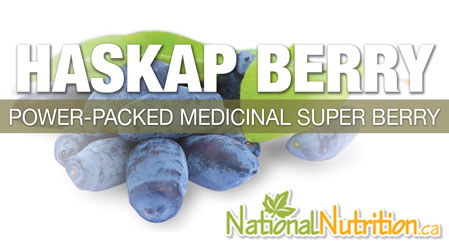
Haskap Berries resemble oblong blueberries
Haskap Berries: A Nutritional Powerhouse
Updated Feb. 13th, 2025 | Read Time: 3 Minutes | What You Will Learn:
- What Are Haskap Berries?
- Top Health Benefits of Haskap Berries
- Understand How Haskap Berries Work In Your Body
- Adding Haskap To Your Routine
- Nutritional Information
- Reader Comments (8)
With a long-standing tradition of medicinal use in Japan, Haskap berries have strong medicinal properties and are grown wild and cultivated right here in Canada.
Haskap is a deciduous shrub reaching 1 – 2 m tall, which produces dark blue to almost purple oblong berries approximately 1 cm in length. Unlike blueberries, Haskap berries' flesh is also purple, making it 5 times more potent in polyphenols than blueberries.
With a fruity tangy zing, they taste great, like a cross between a raspberry, blueberry and black currant.
What Are Haskap Berries?
Haskap is the Japanese name for the plant Lonicera caerulea, also known as Edible Blue Honeysuckle. Haskap has been known as a longevity fruit in Japan for thousands of years. It's native to the northern boreal forests of Asia, North America and Europe. It's generally found in low-lying wet areas or high in mountains. Farmers have been cultivating Haskap berries in Canada since the 50's and it's been found in the wild all across Canada, except for BC.
Top Health Benefits of Haskap Berries
One of the most exciting findings about Haskap berries is it has the highest Anthocyanin content of any fruit. Laboratory analysis also shows it's high in Vitamin C, Vitamin A, fibre and potassium.
ORAC value is a testable measurement of the antioxidant quality of a product. Haskap tests very high in ORAC value.
ORAC measurement specifically assesses Haskap to have:
• Overall Total ORAC Value - 13400 mmoles TE/100gms
• Specific Total Phenolics – 1014mg/100gms
• Specific Total Anthocyanins – 949mg/100gms
• Specific Total Bioflavonoids – 887mg/100mg
Haskap also contains the minerals: Calcium, Magnesium, Manganese, Iron, Zinc and Copper.
Because of its high concentration of antioxidants, Haskap can be used for many conditions and prevention of disease.
It's most commonly used for cardiovascular disease and prevention and anti-aging and vision support.
Understand How Haskap Berries Work In Your Body
How Haskap berries work is via its strong antioxidant content. Antioxidants are compounds which neutralize free radicals which come from toxins, food, air pollution, chemicals, medications and your body's production of waste. There are many types of antioxidants in nature, three of which are Phenolics (or polyphenols), Bioflavonoids and Anthocyanins.
In a comparative chart above, we see that Haskap has the highest content of total antioxidants than any common berry.
By neutralizing free radicals in your body you are preventing oxidative damage to your arteries, eyes, skin, liver and brain. This prevents the build-up of arterial plaque in your arteries, prevents cataracts and retinal damage to your eyes, and the development of plaque in your brain. It also keeps your skin looking younger and longer.
Preventing oxidative and free radical damage also helps keep your cells healthy because it prevents unhealthy cellular changes.
Adding Haskap To Your Routine
Haskap berries can be found fresh or frozen, in jams, wine and in powdered form.
You can eat them fresh or frozen daily on hot cereal, in health shakes or added to food.












