

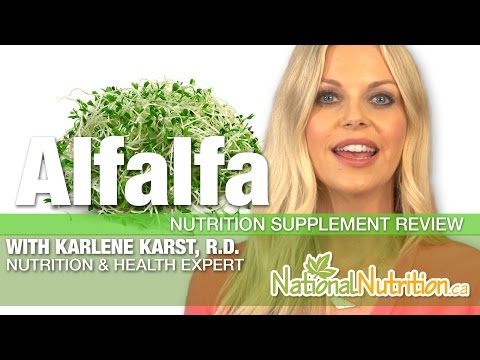
Alfalfa: An Herb For Detoxification
Updated Aug. 30th, 2024 | Read Time: 2 Minutes | What You Will Learn:
- Health Benefits of Alfalfa
- Alfalfa Supplement Varieties
- Cautions, Side Effects & Contraindications
- Nutritional Information
- Reader Comments (12)
Alfalfa is a root that can grow over 100 feet into the earth. Its deep roots allow it to concentrate many different types of vitamins and minerals from the soil. It is used medicinally for its health benefits as general tonic due to its reputation as a balanced source of vitamins and minerals.
Health Benefits of Alfalfa
It has been shown to help arthritis pain and have a positive effect on cholesterol by decreasing cholesterol and inhibiting intestinal resorption to reduce atherosclerotic build-up in arteries. Alfalfa contains a significant amount of vitamin K and other chemicals that thin the blood. The isoflavones in alfalfa are similar to those that are found in soy and red clover. These substances have proven useful in the treatment of menopause and menstrual discomforts. The chlorophyll, green pigment, in alfalfa offers health benefits that aid the healing of intestinal ulcers, hemorrhoids, bleeding gums, burns and infections. Chlorophyll induces detoxification of the body and decreases halitosis and body odour.
Alfalfa Supplement Varieties
Alfalfa can be used as raw sprouts, seeds, dried herb or liquid extract. The raw herb can be found as a powder or compressed into tablets. Fresh alfalfa should be well washed and checked for molds before being consumed. The liquid extract contains a significant amount of chlorophyll.
Cautions, Side Effects & Contraindications
While alfalfa offers plenty of health benefits, the use of alfalfa is contraindicated for those with lupus. There are possible interactions between alfalfa and blood thinners, hormone replacement therapy and oral contraceptives. Alfalfa tea has been historically used as a nutritious tonic in pregnancy but one should exercise caution because of the hormonal properties of alfalfa.













En lisant l’article je ne pensait pas que l’alfafa était bonne pour les hémorroïdes.
……
Reading the article I didn't think alfafa was good for hemorrhoids.
Hello Maryse,
Thanks for sharing, we're glad our article was able to teach you something new! Hope you enjoy more of our articles & recipes.
Stay well!
This is an excellent product to relieve arthritis pain. Must better than pharmaceutical products.
Hello Sharon,
Thank you for sharing your experience with alfalfa! We're glad to hear this has worked well for your health concerns. Indeed alfalfa has been known to support healthy cholesterol levels and symptoms of arthritis-like you mentioned. If you're interested in learning more about supplements that support arthritis, check out our health concern articles:
https://www.nationalnutrition.ca/articles/health-concerns/rheumatoid-arthritis/
Have a healthy day!
I’ve used this to treat arthritis It works wonderful to aid the pin of arthritis.
Hello, Sharon
That’s great to hear, thank you for sharing how alfalfa has helped support your health. Curcumin also has joint health benefits: https://www.nationalnutrition.ca/articles/research/curcumin-and-joints/
Stay healthy
It is so interesting to read about how Alfalfa can be used for arthritis pains and how those in the comments here have also advocated for how the use of Alfalfa has helped them with their arthritis pain as well. In the article, it says that Alfalfa can be taken as a supplement in liquid form as well. I wonder if making it into a balm would also help and then you can use it to put over the area that is in need of some relief.
Hello O,
Absolutely! It's fascinating to learn about the potential benefits of Alfalfa for arthritis pain. Making it into a balm sounds like a great idea! Applying it directly to the affected area could potentially provide targeted relief. It's always worth trying different methods to find what works best for you. If you do decide to make an Alfalfa balm, make sure to research proper preparation techniques and consult with a healthcare professional if needed. Wishing you all the best in finding relief for your arthritis pain and check out our articles on health concerns here: https://www.nationalnutrition.ca/articles/health-concerns/
While toxicity of alfalfa is very rare and as you mention, alfalfa has many health benefits (it is a veritable superfood for most people), there are a few concerns with alfalfa, some of which you mention:
1) There possible interactions between alfalfa and blood thinners, hormone replacement therapy and oral contraceptives, the latter two due to alfalfa's hormone-modulating ability
2) Alfalfa is contraindicated for those with lupus (I wonder why!)
3) Alfalfa sprouts present a food poisoning risk and caution should be following with sourcing, inspection, and preparation in order to keep safe.
This said, most people should be able to enjoy alfalfa free of problems...and the pain relief properties I didn't know about so thank you for teaching me something new, NN!
Hello Rachel,
Thank you for your comment about your key takeaways. Indeed, like any supplement, those on other medications should check the contraindications or consult with their healthcare practitioner prior to adding new supplements to their regimen. You can learn more about natural ways to combat joint pain with this article, too: https://www.nationalnutrition.ca/articles/research/curcumin-and-joints/
I know it's good for detox. Is it good to mix it with other detox supplements? All mixed together in a citrus smoothie? How about mixing in Milk Thistle? Kelp? Dandelion? Cilantro? Parsley? I am trying to maximize the detox without wasting any supplements. I was thinking a tiny bit of each? I am also growing my own alfalfa sprouts at home. And I have it as a tea as well. Should I just eat the sprouts in my soups and salads? Can I maximize their benefits even more?
Hello,
Thank you for your comments. It's important to research if there's a contraindication between herbs and to see which other supplements will boost the bioavailability of the herbs you're taking. For instance, vitamin C should be taken with iron to help boost its absorbability. Also, your body can only absorb so many nutrients at a time, so sometimes taking everything at once is counterproductive.
You can mix sprouts and seed in salads, soups and sprinkled in other recipes. If you'd like to find more healthy recipes, check out this section on our site: https://www.nationalnutrition.ca/articles/healthy-recipes/