

Bee Supplements
What Are Bee Supplements?
As children, we learn that bees make honey and cows produce milk. In fact, a variety of children's books explain these incredible facts in great detail. However, we seldom hear about the other potent, nutrient-dense products that bees also produce, like bee pollen, beeswax, propolis, and royal jelly, many of which are powerful superfoods and all of which offer myriad impressive health benefits. Let’s take a look at each of these little wonders more closely: Read more >-
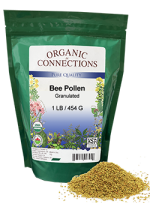
Organic Connections carefully harvests their bee pollen to not endanger or harm the bees. The organic pollen is then dried and made into granules that you can add to your granola, yogurt, smoothies and other recipes. Due to its oleanolic acid and triterpene bond content, bee pollen has a bitter taste and has long been used to help decrease inflammation, offer immune support, and support wound h...
+ Earn 29 Reward PointsSale: $29.99
Reg.: $36.08 (Save $6.09)
Out of Stock
Get Notified When in Stock
What Are Bee Supplements?
As children, we learn that bees make honey and cows produce milk. In fact, a variety of children's books explain these incredible facts in great detail. However, we seldom hear about the other potent, nutrient-dense bee supplements that bees also produce, like bee pollen, beeswax, propolis, and royal jelly, many of which are powerful superfoods and all of which offer myriad impressive health benefits. Let’s take a look at each of these little wonders more closely:
Honey— a well-known bee supplement, honey is the decadent, sweet, and viscous substance made by honeybees. Bees produce honey by gathering and then refining the sugary secretions of plants (nectar) or the secretions of other insects, like the honeydew of aphids. This sweet nectar is stockpiled in the hive within a wax structure known as a honeycomb. It is intended as food to nourish colonies and provides all of the energy they need. Honey also provides heating for the hive in the winter. Fortunately, honey bees make far more honey than the colony can use, which is where beekeepers come in to harvest the excess, bottle it, and make it available to us.
From a nutritional perspective, raw, unpasteurized honey is a natural source of sugar. It is also great for soothing sore throats and can help boost energy, remedy sleep problems, and quell seasonal allergies. Raw honey has also been shown to be effective at supporting weight-loss efforts.
Bee pollen, also known as "bee bread" and "ambrosia," is another one of many bee supplements. It's a pellet packed by worker honeybees and used as the primary food source for the hive. Bee pollen is one of the most nutritionally dense foods known. In fact, it contains almost all the nutrients the human body requires, which is why the German Federal Board of Health considers bee pollen a medicine. Nutritionally, bee pollen is rich in vitamins, minerals, proteins, lipids and fatty acids, enzymes, carotenoids, and bioflavonoids. It also contains more protein than any animal source and more amino acids than eggs or beef.
Bee pollen also contains over 250 active substances, which endow it with potent antibacterial, anti-histamine, antifungal, and antiviral properties. It is often recommended to boost the immune system, kill bacteria, temper inflammation, fight free radicals, protect against heart disease, promote liver function, relieve allergies, strengthen the capillaries, and aid wound healing.
Beeswax: Beeswax is produced from glands in the abdomen of honeybees and is used to create the hive itself. The female worker bees have eight of these glands, which are reserved for when it is time to build the honeycomb. The secreted wax hardens as soon as it hits the air and forms a wax scale.
The hive workers collect and use this hardened wax to form honey storage cells and protect larvae within the hive. Chemically speaking, beeswax is composed primarily of fatty acid esters and various long-chain alcohols.
Beeswax is a great bee supplement because, you might be surprised to know that beeswax has been used in medicinal applications for thousands of years and is still widely used today. Some of beeswax's most common therapeutic applications include treating skin conditions such as eczema, acne, diaper rash, psoriasis, and fungal infections. It can also protect the skin from environmental irritants and harsh weather by forming a protective barrier on the skin's surface. It’s also excellent for swelling, inflammation, and fungal infections, lowering cholesterol, and relieving pain. Interestingly, beeswax also happens to be a hepatoprotectant.
Propolis is another highly beneficial bee product that offers robust therapeutic properties. It may best be described as “bee glue” and is a resin-like mixture produced by honeybees that combines saliva and beeswax with exudate from tree buds, sap flows, or other botanical sources. Honeybees use propolis to seal unwanted open spaces in the beehive to guard against intruders. Propolis is usually dark brown but can oscillate from yellow-green to red and dark brown, depending on its source and age.
Bee propolis is an excellent bee supplement that contains over 300 bioactive compounds, including amino acids, coumarins, phenolic aldehydes, polyphenols, sesquiterpene quinines, and steroids. Moreover, propolis has been used medicinally for thousands of years thanks to its potent antimicrobial, antifungal, antioxidative, anti-parasitic, anti-ulcer, and anti-tumour properties.
Royal Jelly – is a milky substance secreted by nurse bees and used as nutrition for developing larvae and their queen bee. Interestingly, while all larvae in the colony are fed royal jelly, regardless of gender or caste, nurse bees select 10 to 20 newly hatched female larvae and begin feeding them copious amounts of royal jelly. This type of feeding triggers the development of queen morphology, including the fully developed ovaries needed to lay eggs.
Like other bee products, royal jelly can be consumed and offers significant health benefits, including as an asthma remedy, promoting healthy bone development, as an anti-aging nutrient, and boosting overall immune function. Royal jelly is also frequently recommended to support the body in cases of kidney, liver, and pancreatic disease; promote energy and vitality (including pre-workout); aid digestion; regulate glycemia; accelerate wound healing; and provide cognitive support.
Choosing the Best Bee Supplements for You
Bee products come in all sorts of forms and formats. Those who prefer going the natural "food state" route can purchase propolis, bee pollen, or royal jelly in their raw form. For convenience's sake, most bee products are also offered as supplements in the form of capsules, tablets, extracts, tinctures, powders, sprays, ointments, creams, and others. Honey is widely available in food form in grocery stores, health food stores, and online. Look for raw, unpasteurized honey to get the most nutrition and flavour possible.
Back to Top ↑








