- 70 mg
- Calcium
- 8 mg
- Phosphorus
- 300 mg
- Potassium
- 10 mg
- Magnesium
- 20 mg
- Silica
- 0.13 mg
- Thiamine
- 0.10 mg
- Niacin
- 0.06 mg
- Riboflavin
- 10 mg
- Sodium
- 1.20 mg
- Iron
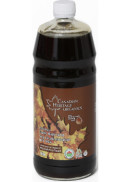
Organic Maple Syrup
Proud Canadian Company, Certified Organic
 Liquid
1l
Can replace table sugar 1:1 in sweetening all beverages & baking
- Deep, rich dark colour
- Organic
- Delicious, Canadian classic!
- Nutrient rich and full of antioxidants
- A perfect multi-purpose sweetener for beverages, fresh fruit and general table-top use

- Reviews
- POST A NEW REVIEW
Reviews By Rating
helpful votes
0
0 customers found this product review helpful
Maple Syrup was founded by the North American Indians, and used as a spring tonic. Maple Syrup is the boiled, condensed sap of maple trees. Of the six species of maple trees native to Quebec, only two supply suitable sap for syrup, the Sugar Maple (Canadian National Emblem) and the Red Maple. Maple Sugar is a brown, crystalline sugar obtained from Maple Syrup. Approximately 36 to 44 gallons of sap is evaporated just to make 1 gallon of Maple Syrup.
Why Canadian Heritage Organics?
No chemical fertilizers, pesticides, phytocides, etc. are used in the maple bush or in the area where organic products are processed. Limited number of tapholes per tree with no over-tapping. No germicides (paraformaldehyde) in tapholes. There is no lead or lead solder used in the equipment required for processing Canadian Heritage Organics, Organic Maple Products, consequently, there is no lead in the finished product. Lead can be a concern with some conventional maple syrup producers using older equipment. No synthetic chemical products are used to control foam during boiling. No treatment of sap with ultra-violet radiation. No microwave cooking of processed organic maple products. No processing of non-organic and organic products on the same site.
How Is Maple Syrup Graded?
Golden, Delicate taste
This syrup comes from maple sap harvested at the very beginning of the sugaring-off season. It’s distinguished by its light golden hue and sweet, delicate flavour. It’s a delicious topping for yogourt and ice cream.
Amber, Rich taste
This syrup has a pure, rich taste and a magnificent amber colouring. It’s ideal as an ingredient in vinaigrettes and all sorts of dishes and desserts.
Dark, Robust taste
This syrup, with its more pronounced, caramelized flavour, is well-suited for cooking, baking, and sauces. It’s celebrated for the way it enhances the taste of fruity dishes.
Very Dark, Strong taste
This syrup is the product of maple sap harvested at the end of the sugaring-off season. Its flavour, more pronounced than any of the previously-listed syrups, is rich and distinctive. It colours and perfumes sauces and glazes to perfection.
Sugar & Alternatives
And for all of you skeptics out there, it really is do-able. After you have gone sugar free for a couple weeks, you will notice that you crave less and your taste buds will become much more sensitive to sweet meaning once you have sugar again, it takes very little to do the trick.
What's so wrong with sugar?
It's really all about the amount of sugar we are eating. Among one of the most concerning side effects, in my opinion, is sugar's effect on the immune system. Research has clearly shown that sugar slows the immune response. Glucose also leads to increased insulin release, which prevents the synthesis and release of growth hormone. Growth hormone, as the name implies is responsible for normal growth and development and without it, growth deficiencies develop. The impact that sugar has on the immune system is the most profound at approximately 2 hours after ingestion, when immune cells are at their lowest. What I find even more concerning is that at 5 hours, although better, this suppression is still noticeable. If you are someone that enjoys a little sweet with all of their meals or snacks, your immune system could actually never be working at its full capacity!!!
There is also a growing concern in today's society about obesity and maybe most concerning, childhood obesity. We have come to understand over the past decade that this may have much more to do with sugar than it does with fat. Foods high in sugar/glucose force the body to release insulin in high amounts in order to get glucose into the cells to use for energy. What we do not use immediately gets stored as fat or triglycerides. Regular ingestion of foods that are high in sugar or cause an extremely quick or high rise in blood sugar will lead to more triglycerides being produced than the body can ever manage to use. In this sense, a high sugar diet will lead to weight gain and most likely cardiovascular issues down the road.
Where is the sugar?
A lot of sugar can be hidden in products that there is simply no need for sugar to be. The highest source, by far is Pop (Soda), followed closely by sports drinks, fruit juice, prepared or ready made foods, ketchup, peanut butter, breakfast cereals and virtually anything that is advertised as low fat. These sugars are commonly in the form of high fructose corn syrup (HFCS). This is why label reading is so important, anything that lists corn syrup, sugar, sucrose or a similar "_ose" in the first 3 ingredients, is going to be very high in sugar. Keep in mind, this also means it is bound to be pretty high in calories, as well.
As a general rule, stay away from anything that says high fructose corn syrup (or just corn syrup) on the label, not only is it extremely sweet but it is nutritionally deplete and has a very high glycemic index, meaning it quickly and significantly increases blood sugar.
Maple syrup -I have a personal weakness for maple syrup and although it is still a better alternative than sugar, absolutely, it is also a processed alternative. It is also a little higher on the glycemic index than some of the other alternatives. All that aside, in moderation, maple syrup is nutrient rich and full of antioxidants.
Back to Top ↑