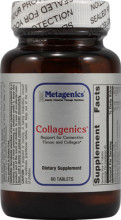
Each tablet contains:
- 50 mg
- Vitamin C (ascorbic acid)
- 50 mg
- L-Proline
- 50 mg
- L-Cystine
- 50 mg
- Methylsulfonylmethane (MSM)
- 50 mg
- L-Lysine (L-lysine HCl)
- 25 mg
- Magnesium (magnesium bisglycinate)
- 25 mg
- Horsetail (Equisetum arvense L.) 4:1 stem and leaf extract
- 25 mg
- AD-Xylose
- 10 mg
- Vitamin B6 (pyridoxine HCl)
- 10 mg
- Pantothenic Acid (D-calcium pantothenate)
- 10 mg
- Taurine
- 5 mg
- Zinc (zinc glycinate)
- 5 mg
- Alpha-Ketoglutaric Acid
- 2 mg
- Iron (iron glycinate)
- 1.65 mg
- Manganese (manganese citrate)
- 1 mg
- Copper (copper citrate)
Non-Medicinal Ingredients:
Cellulose, croscarmellose sodium, stearic acid (veg.), silicon dioxide, magnesium stearate (veg.), and coating (hypromellose, hydroxypropylcellulose, and medium chain triglycerides).
Cellulose, croscarmellose sodium, stearic acid (veg.), silicon dioxide, magnesium stearate (veg.), and coating (hypromellose, hydroxypropylcellulose, and medium chain triglycerides).
Important Information:
Consult your health care practitioner if you are pregnant or breast feeding or if you have a liver disorder. Keep out or reach of children. There is enough iron in the packaging to seriously harm a child.
Format
 Tablets
60 Tabs
Dosage
Adults take two tablets two times daily or as directed by your healthcare practitioner. Take with food a few hours before or after taking other medications.
Product Information:
- Promotes the growth of connective tissues
- Provides support for strong skin, tendons, ligaments, joints, cartilage, and bones
- Supplies a blend of natural ingredients to support underlying processes in maintaining healthy connective tissue.
- Improves the health of connective tissue

Premium Metagenics Formulas for Whole‑Body Health
For over 30 years, Metagenics has been dedicated to scientific discovery and bringing you the highest quality supplements. Some of Metagenics most popular supplements inlcude Metagenics Ultra Flora, Probiotics, Phytomulti, Clear Change, Ultra Glucose Control, Candibactin-BR and Candibactin-AR. From gluten-free to non-GMO, Metagenics aims to deliver clear and accurately labeled nutritional solutions with over 120 vegetarian supplements. Read more >What Customers Are Saying:
- Reviews
- POST A NEW REVIEW
More Info
COLLAGEN II
Type II collagen is the main protein building block of the cartilage in our joints ...
Type II collagen (collagen type II) is the primary component of all of the cartilage in our body, particularly the subtype known as hyaline cartilage. Cartilage is the connective tissue pad that acts as a cushion and eliminates friction in your joints. These cushions are found in all the joints of the body, including the knees, elbows, and between the vertebrae in the spine. Natural healthcare practitioners use type II collagen to support healthy cartilage synthesis in the body. For more information, please see our Collagen article.
Aging and Cartillage Loss
As we age, our body's ability to make type II collagen decreases. At the same time loss of type II collagen from the cartilage decreases its integrity, making it less resilient. This type of degeneration is often associated with osteoarthritis, and is the reason we are more inclined to have "wear and tear" problems as we age. This loss of cartilage is accelerated by the presence of the stress hormone cortisol. Thus, stress reduction can help to protect the joint cartilage of the body.
Joint Wear and Osteoarthritis
Wear-and-tear injuries occur in the joint cartilage from overuse and cause less support, less cushioning and more friction. As a supplement collagen acts as a source of amino acids for use in making and repairing connective tissue all over the body. Supplementation with type II collagen can help to support proper cartilage synthesis and help to repair the degeneration associated with osteoarthritis. Type II collagen also has anti-inflammatory properties, which help the joint to repair itself after injury, and prevent inflammatory destruction. This can also be beneficial in rheumatoid arthritis (RA).
How can I take type II collagen?
Type II collagen can be found as an encapsulated powder or liquid. It is commonly called hyaline cartilage when seen in supplements. In general, it is combined with other joint repairing nutrients and vitamins. Type II collagen is found as a component of both pain relieving and anti-inflammatory formulas. Collagen type I and III are also available and should be used after good results are found with type II to further rebuild damaged joints or tissue. For more information on their use, please see our Collagen Type I & III article. Depending on the severity of joint destruction collagen may need to be taken for a few months before results are seen.
Collagen II - QUICK FACTS
SOURCES
Bovine.
APPLICATIONS
Arthritis, skin ulcers due to vascular insufficiency, burns, wounds.
OPTIMUM DOSAGE
600-1200 mg daily. (Clinical doses may be higher as recommended by your practitioner).
WORKS WELL WITH
Vitamin C, Chondroitin sulfate, MSM, glucosamine, calendula, vitamin E.
IMPORTANT INFORMATION
There is no toxicity, side effects or contraindications for the use of collagen.
Collagen should be taken with a juice that is high in Vitamin C or a vitamin C tablet.
Type II collagen is the main protein building block of the cartilage in our joints ...
Type II collagen (collagen type II) is the primary component of all of the cartilage in our body, particularly the subtype known as hyaline cartilage. Cartilage is the connective tissue pad that acts as a cushion and eliminates friction in your joints. These cushions are found in all the joints of the body, including the knees, elbows, and between the vertebrae in the spine. Natural healthcare practitioners use type II collagen to support healthy cartilage synthesis in the body. For more information, please see our Collagen article.
Aging and Cartillage Loss
As we age, our body's ability to make type II collagen decreases. At the same time loss of type II collagen from the cartilage decreases its integrity, making it less resilient. This type of degeneration is often associated with osteoarthritis, and is the reason we are more inclined to have "wear and tear" problems as we age. This loss of cartilage is accelerated by the presence of the stress hormone cortisol. Thus, stress reduction can help to protect the joint cartilage of the body.
Joint Wear and Osteoarthritis
Wear-and-tear injuries occur in the joint cartilage from overuse and cause less support, less cushioning and more friction. As a supplement collagen acts as a source of amino acids for use in making and repairing connective tissue all over the body. Supplementation with type II collagen can help to support proper cartilage synthesis and help to repair the degeneration associated with osteoarthritis. Type II collagen also has anti-inflammatory properties, which help the joint to repair itself after injury, and prevent inflammatory destruction. This can also be beneficial in rheumatoid arthritis (RA).
How can I take type II collagen?
Type II collagen can be found as an encapsulated powder or liquid. It is commonly called hyaline cartilage when seen in supplements. In general, it is combined with other joint repairing nutrients and vitamins. Type II collagen is found as a component of both pain relieving and anti-inflammatory formulas. Collagen type I and III are also available and should be used after good results are found with type II to further rebuild damaged joints or tissue. For more information on their use, please see our Collagen Type I & III article. Depending on the severity of joint destruction collagen may need to be taken for a few months before results are seen.
Collagen II - QUICK FACTS
SOURCES
APPLICATIONS
OPTIMUM DOSAGE
WORKS WELL WITH
IMPORTANT INFORMATION
Back to Top ↑