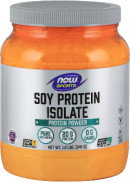
- 90
- Calories
- 5
- Calories from Fat
- 0.5 g
- Total Fat
- 0.5 g
- Total Carbohydrate
- 20 g
- Protein
- 170 mg
- Calcium
- 3 mg
- Iron
- 20 mg
- Magnesium
- 200 mg
- Sodium
- 80 mg
- Potassium
Non-GMO soy protein isolate
Free of: sugar, salt, starch, yeast, wheat, corn, milk, egg, shellfish or preservatives. Non-GMO
 Powder
544g
As a dietary supplement, mix a 1/3 cup of soy protein isolate powder daily into at least 8 oz. of water, milk, or juice. Add fruit and ice, if desired, and blend.
- Athletic performance
- Build immune function
- Weight management
- Support estrogen levels
- Vegetarian/Vegan Product

- Reviews
- POST A NEW REVIEW
Reviews By Rating
helpful votes
1
1 customers found this product review helpful
Sports Nutrition
Athletes are one of the most unique breeds of life roaming the earth. On the surface, their traits are simple; sweat beaded foreheads, high-tech stop watches, chiseled physiques, running shoes, corporately endorsed attire, etc. But when you take just a moment to peer into what really makes an athlete an athlete, it's becomes easy to see what sets them apart.
From bikers to bodybuilders, sprinters to swimmers, athletes epitomize what it means to be alive. These modern day, physically motivated warriors thrive on personal achievement, lament the thought of failure and in the process, subject their bodies to immeasurable amounts of pain and exhaustion. But these aren't just traits to an athlete they're prerequisites.
When you consider the enormous nutritional needs of the average busy adult, then and only then, can you begin to appreciate what the most physically active individuals require in order to succeed. And while these needs vary from sport to sport and lifestyle to lifestyle, there's simply no denying their never-ending need to fuel, refuel and repeat. So whether you're just starting out, or make it your life's work, here are a few ways to get the most out of your training.
Essential electrolytes
Every human being is at the mercy of their diet to provide them with a solid foundation of nutrients. This is especially true in the case of endurance athletes, bodybuilders and other adrenaline-seek- ing competitors. During intense physical training, the body calls upon its reserve of electrolytes such as potassium, magnesium, calcium and sodium to provide the spark needed for increased respiration, muscle contractions, nerve impulses and countless other functions.
A well-stocked cellular arsenal of these nutrients can ultimately lead to greater levels of sustained endurance, muscular strength and mental clarity. Deprivation, on the other hand, is an invitation for disaster. When the body is pushed to extremes, but unable to locate what it needs, it becomes prone to fatigue, cramping, nausea and headaches. Not to mention, last place. Products such as Carbo Gain and ZMA can provide a solid base of nutrients. (See reverse for detailed specifications).
Protein for optimal performance
Sending a frail, malnourished warrior into battle is the biological equivalent of trying to win the Daytona 500 on a set of roller-skates. Under no circumstances should this be attempted. Though popularized by bodybuilders, protein supplementation is imperative for athletes at every stage and skill set. Its role in muscular development still accounts for its unceasing popularity, though many users don't realize that protein has many other responsibilities.
As one of the body's key structural building-blocks, the amino acids in protein are actively involved in the repair and development of muscle fibres, hormone, antibodies and enzymes each one vital to the success of any hard working athlete. Over the past 10 years or so, the science of isolating and manufacturing protein supplements has advanced far beyond what anyone could have possibly predicted. Today's products are very pleasant tasting, highly bioavailable (easy to absorb), nutritionally optimized and available in a number of different flavors.
The edge
If you consider yourself a serious, competition minded athlete, you already know how important the "edge" is when it comes to your success. Regardless of whether it's shaving a second off your personal best, squeezing out one more rep on the bench, or bumping up your batting average by just a tenth of a point, the difference between achieving first place and an honorable mention may be a simple as knowing what specialty nutrients can make it so.
Thanks to impressive advances in the science of sports nutrition, there are plenty to choose from these days. Creatine monohydrate, for example, helps foster the production of adenosine triphosphate (ATP), a mitochondrial chemical that makes it possible to store, produce and use energy for muscular contractions. Another, branched chain amino acids (BCAA), help increase protein synthesis by promoting anabolic balance by preventing the catabolism that typically occurs during intense training. Pyruvate, a unique pairing of calcium and pyruvic acid, helps facilitate the transfer of glucose from the bloodstream into muscles where it supports the production of metabolic energy.
When it comes to fueling your body with the nu- trients and compounds it needs to perform at its pinnacle, quality takes top priority. Purchasing a line of supplements based on the allure of the label won't do a thing for your ability to improve, physically. In fact, it may end up costing you more than just money in the long run.
NOW Sports supplements are developed under the same demanding, science-based standards inherent to every NOW product, and guaranteed to be exceptional in potency, purity and quality. For a complete listing of products or for more information, please visit www.nowsportsproducts.com.
What is Soy Good For? What are the Ingredients and Content?
Research has shown soy products to be an excellent addition to any diet. Eastern cultures have traditionally consumed diets high in soy content, and the incidence of certain diseases have been significantly lower in Eastern cultures. Western cultures, which consume diets high in animal fats, appear to have higher incidences of certain diseases, as well as obesity. Although research is ongoing, scientists believe the isoflavone content of natural soy may be responsible for its health benefits. In fact, the FDA has approved a statement to be used in the labeling of qualified soy products:
Calculating the isoflavone content of any Soy product is fairly simple. Generally speaking, there are 2 mg of soy isoflavones per gram of Soy Protein. Take the protein content of a Soy product from NOW and multiply it by two, then convert to milligrams. For example, if Soy Milk powder contains 9 grams of protein per serving, multiply 9 times 2 for 18, then convert to milligrams, for a total of 18 mg of isoflavones per serving.
Soy Protein is one of our most popular Soy products. We use the Supro brand of Soy Protein Isolate, one of the highest quality forms of this nutrient. On the label of this product, it states that the product contains 90% Soy Protein. The other 10% is composed of moisture and naturally occurring minerals. Each serving may contain up to 42 mg of naturally occurring soy isoflavones per serving, with the average falling in the mid-30 mg range. We do not add isoflavones to any of our Soy products all isoflavones are naturally occurring. Soy Protein contains no wheat, barley, rye or oat-based fillers, and no chemicals are used in the extraction process - water only (hydrolysis). It is usually mixed into drinks or shakes, but can be used in baking applications if desired. Since it is a pure protein product, there are no carbohydrates in Soy Protein Powder.
The soybeans used to produce NOW Soy products contain naturally occurring oxalic acid, but the levels are extremely low and do not pose a concern for persons sensitive to this compound. Avoid foods like spinach, cabbage, rhubarb, sorrel and black tea. These foods are generally high in oxalic acid.
Are your soy products GE-free?
Many of our Soy products are GE-free, and we are adding to this list often. All of our non-GE Soy products are clearly labeled as such on the principal display panel (front of label). If non-GE does not appear on the labeling of a Soy product, it is not free of genetically modified organisms. Do not confuse organic with non-GE they are not the same. While organic products are GE-free, there are other factors that qualify a product as organic that do not apply to non-GE products. As with non-GE Soy products, organic Soy products are clearly labeled as such.
NOW carries an extensive line of regular and GE-free Soy products.
What is the equivalency between cooked and uncooked Soybeans?
Many people like to consume uncooked soybeans instead of cooking them, but aren't sure of the equivalency between cooked and uncooked soybeans. When consuming uncooked soybeans, 1/3 cup equals 1 cup of cooked soybeans. Cooked or uncooked, Soybeans are a great source of natural nutrients!
How do I reconstitute NOW Soy Powder or Soy Milk Powder?
Due to space limitations in the labeling of our Soy Powder and Soy Milk Powder, reconstitution instructions were not included on the package. Mix cup of Soy Powder with 8 to 10 ounces of water for reconstitution purposes. Soy Milk made with Now Soy Powder or Soy Milk Powder is delicious, nutritious, and usually less expensive than pre-packaged soy milk brands. Also, there are no additives or preservatives.
25 grams of soy protein a day, as part of a diet low in saturated fat and cholesterol, may reduce the risk of heart disease.
NOW Soy Milk Powder doesn't contain mixing instructions. How much powder do I use to make a quart of Soy Milk?
For one quart of Soy Milk, mix cup in 8-10 ounces of water. This product is instantized and should mix easily. NOW Soy Milk Powder is free of genetically engineered ingredients.
Back to Top ↑