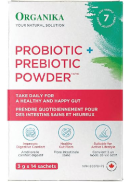
- 100 Million CFU
- Bifidobacterium animalis subsp. lactis (Whole Cell (SD-5220))
- 100 Million CFU
- Lactobacillus acidophilus (Whole Cell (B-3208))
- 25 Million CFU
- Bifidobacterium bifidum (Whole Cell (SD-5215))
- 25 Million CFU
- Bifidobacterium longum subsp. longum (Whole Cell (SD-5588))
- 2 500 mg
- Actilight Prebiotic Fibre / FOS (Beta vulgaris) (Root)
D-Fructose, Orange Flavour, Silicon Dioxide.
Keep out of the reach of children. Sealed for your protection. Do not accept product if safety seal is broken.
 Packets
14 Sachets
Take it with water or on its own: just sprinkle, let melt, and go! Take 2 times a day. If you are taking antibiotics, take 2-3 hours before or after.
- Improves digestive discomfort due to mild functional bowel disorders
- Helps support intestinal health and promote a balanced gut flora
- Stimulates the growth of healthy bacteria in the gut
- Source of fiber for the maintenance of good health
- Shelf stable
- 250 million CFU guaranteed live bacteria
- Free from dairy, egg, artificial preservatives, colours, sweeteners, yeast, wheat, soy, gluten, GMO

Nourishment Rooted in Nature - 12 New Added
Organika, formulators of Canada’s best-selling Collagen and marine collagen and Bone Broth supports skin and joint health. Organika's health products also include; Organika spirulina, Chlorella, Curcumin to support inflammation, Organika Enhanced Collagen Protein, and Adaptogens to provide balance. Shop Organika here at National Nutrition.ca for quality, Canadian-made supplements. Read more >- Reviews
- POST A NEW REVIEW
PROBIOTICS
By: Articles by a Naturopathic Doctor and a Holistic Nutritionist
Probiotics aren't just essential for digestive and colon health, they also boost your health in general...
Probiotics are the beneficial microbial flora that we all need for optimal health. These "good" bacteria (and yeast) colonize our digestive and urinary tracts and the vagina in women where they grow and help to maintain the health of our mucous membranes. You can think of this in the same way as sowing your lawn with grass seed to create a thick, lush carpet of grass that can protect against the growth of weeds.
Probiotics seed your body with beneficial bacteria to help protect against the growth of pathological ("bad") microbes like E. coli and Candida. This helps no matter the location of the mucous membrane in the body: whether the vagina, bladder or GI tract. In the gut they also promote proper digestion and in some cases actually produce or functionally convert essential nutrients for our absorption and use. Many normal, bodily functions require healthy gut flora, and their effects range from healthy immune function to proper heart function and skin health.
The Types Of Friendly Bacteria
In general, probiotics can be categorized by where they are used in the body. For example, there are friendly bacteria, which only grow in the small intestine and those that proliferate only in the large intestine (colon). But, believe it or not, beneficial bacteria exist in the mouth, urinary tract, stomach, vagina, and even on the surface of the skin. Certain strains colonize certain areas of the body more easily than others.
Lack Of Healthy Gut Flora
Without healthy gut flora, a number of conditions can result including: poor assimilation of nutrients, intestinal irritation, diarrhea or constipation. Both naturopathic and medical doctors recognize the importance that the gut flora plays in overall health. Certain strains of Lactobacillus have been shown to be crucial for producing important immune factors, while others have been shown to be crucial for the reduction of bad cholesterol. Many infections are more common in those without proper body flora, including: gastroenteritis (the "stomach flu"), vaginal yeast infections, urinary tract infections (UTIs), and even skin conditions like acne.
Immune Regulation
Proper colonization of the gut by beneficial bacteria helps to regulate our entire immune system. Well over 70% of our immune cells are actually located in our gut tissue as "gut associated lymphatic tissue (GALT). These cells are constantly interacting with the bacteria in our gut, and having good bacteria present can help to train our immune system to be properly active against pathogens and tolerant to everything else. This is how probiotics can help to reduce and prevent autoimmune diseases such as: lupus, rheumatoid arthritis, irritable bowel disease, psoriasis, and eczema.
Anti-Infection And Detox
Candida infections can be particularly stubborn and often require long-term use of a probiotic in addition to the use of other therapies. The same need for probiotics exists in instances of food poisoning, which not only deplete gut flora, but can also cause damage to the intestinal lining; the use of a high cell count, therapeutic probiotic is therefore appropriate if you've had food poisoning. Another common use for probiotics is for preventing parasites and diarrhea while traveling. Whether the gut flora has been lost due to diarrhea or due to an intentional cleanse, probiotic supplements can perform a "rebuilding" function, helping to replenish friendly bacteria that have been depleted.
What To Look For In A Probiotic
There are literally thousands of probiotic supplements available in health food stores today; with so many available it can be difficult to know which one is best for you or your family. A multi-strain probiotic is frequently the best way to go for most people. This type of probiotic can supply you with at least 6, 8 or even as many as 10 or 20 different strains of healthy bacteria. Your body naturally contains a wide variety of strains, so it makes sense to take a supplement with as broad a spectrum as possible. This will give you the greatest coverage to replenish or maintain the natural gut flora. The greater the diversity, the greater the strength of your body's flora.
Probiotic Source
There are a number of different sources of probiotics. Some companies get their strains from soil sources (like HSO's), while some get them from lab strains, and still others from strains extracted from healthy human sources. There are a mind-boggling number of strains of bacteria available of each species of bacteria. Lactobacillus acidophilus is a species of bacteria and it has a vast number of different strains that are labeled using a chain of letters and numbers. We know very little about the specific differences of each species, and so the medical community tends to group the bacteria by species and ignore the strain in most cases. In addition to bacteria, some probiotics are other organisms; one great example of this are beneficial yeast called S. boulardii.
Targeted Probiotic Therapy
That being said, there are particular therapeutic probiotics, which are targeted towards certain health concerns. The homeostatic soil organism (HSO) type of probiotic contains healthy bacteria from soils. In years past we would have ingested these from root vegetables grown in the ground, but in our modern sanitized world, where we purchase cleaned vegetables from supermarkets, it's difficult for us to get it from food unless we're growing them ourselves. This particular type of beneficial bacteria has been clinically proven to help remove Candida.
Shelf Stability
Because they are living organisms, probiotics have a shorter shelf life than standard nutritional supplements. It is best to store them in fridge, especially if you aren't going to finish the bottle quickly. When exposed to cooler temperatures, microorganisms slow their metabolism, which brings them near to a point of stasis; This allows them to be stored for longer periods of time without a nutrient source. At room temperature, the organisms must be preserved in some other manner: either chemically in a protective coating (microencapsulation) or they must be stored in much larger concentrations and with a food source such as FOS and glucose so they can "eat" in order to survive. Most high quality supplements intended for the fridge will remain shelf stable with their label count for up to two weeks at room temperature, but prolonged time exposed to elevated temperatures will eventually result in a die off of your chilled probiotic. Research is conflicted about how long probiotics degrade naturally at room temperature, which is likely the result of differences between strains and manufacturing methods. Some healthy gut flora supplements will degrade at less than 5% of the total active cell count under normal cupboard conditions over the span of about thirty days, which will allow them to last for several months without significant losses. Often these are the brands considered to be more shelf stable. Other supplements will lose their entire living microbial count within 2-3 weeks. In general, it is best to follow the instructions on the bottle for storage. Those that say "shelf-stable" are ones that have been properly preserved or have initial counts high enough to last until their expiry date with the counts stated on the label.
Take Them With Or Without Food?
Very recent research has finally solved the "with or without food" debate. It was found that taking probiotics with food helped larger numbers of them (up to 90%) survive into the intestines, vs. 50% survival on an empty stomach. Before, it was thought that taking probiotics on an empty stomach would help more viable bacterial cells to pass through the stomach to reach their destination in the small or large intestines than taking them with food. It turns out that food actually acts as a buffer to reduce stomach acidity and also promotes increased motility in the gut, helping to speed the probiotic to its destination. So it is best to take your probiotic supplement with a meal to improve its function.
Active Cell Count – How Potent Is Your Probiotic?
Unlike vitamins, minerals, and herbs, probiotic supplements are measured by active cell count rather than milligram weight (some bacteria are "fatter" than others). A high potency probiotic would be considered in the 10 billion cell count or higher. These are excellent for use in times of depletion and stress on the gastrointestinal tract. They are also useful during times of infection, where higher probiotic counts can help to out-compete pathological "bugs". For regular maintenance, lesser counts may be sufficient, such as 2-4 billion daily.
Maintenance Supplementation
Some recent research has suggested that following an initial period of high-dose supplementation to seed the gut (perhaps 4 weeks), probiotic supplementation can be dosed in pulses and still maintain its beneficial colonization. Maintenance supplementation can involve 3 weeks of daily supplementation, followed by 4 weeks without supplementation, and beneficial levels of healthy gut bacteria will still be maintained. Unfortunately, because our diets are so far removed from natural sources of beneficial probiotics, maintenance supplementation is often necessary, particularly in individuals with compromised digestion.
How Can I Take Probiotics?
Most probiotics come in powder or capsule form for easy supplementation. They can be mixed with warm or cold food directly (not hot), or simply taken with meals. Other supplements may come in powder and lozenge form probiotics help to inoculate the mouth and esophagus with millions of helpful bacteria. Multi-strain formulas are always the best option to ensure a wider base of colonization and protection. It is best to try to get at least 4 strains, although better products will contain 8 or more. Keep your counts in mind – 10 billion range for initial colonization and maintenance doses can be lower, in the 2+ billion range. Dosing may have to be adapted in times of added stress on the intestinal tract, during time of chemotherapy, antibiotic treatment, or diarrhea. For more information on this sort of dosing, see Dr. Jody's letter on probiotics, here. Some foods are enriched with probiotics, but many do not provide their dose, and they often fall short of what is required. Be sure to use the same requirements in your food sources as in your supplements when choosing where to spend your money on probiotics. When dosing children, the strain ratios and dosages will be different than those for adults. It may be best to purchase products targeted at your child's age range.
Probiotic – Quick Facts
Applications
· Colon Health, Detoxification, Digestion, Chemotherapy, Antibiotic Treatment, Eczema, Allergies, And Diarrhea
Works Well With
· Food, Multivitamins, Vitamin C, Vitamin A, Vitamin E, Essential Fatty Acids, Lecithin, Betonite, Pancreatin, Bromelain, Chlorophyll, Chamomile, Fennel, Gymnema, Milk Thistle, Enteric-Coated Peppermint, Psyllium, Slippery Elm, And Lemon Balm
Important Information
· Some Probiotic Supplements May Contain Dairy Or Other Allergens, Be Sure To Read The Label Closely If You Suffer From Any Allergies Or Intolerances.
· Taking Extremely Large Doses Of Probiotics Can Cause Gas And Bloating. Reducing Your Dose Should Eliminate These Effects.
Back to Top ↑