

Niacin
-
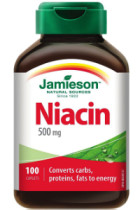
PURE SOURCE VITAMIN B3 Jamieson Niacin is a pure sourced Vitamin B3 formulated to improve circulation, support the digestive system, and increase overall energy level. With no added sugar, starch, gluten, or salt, this Vitamin B3 (Niacin) also helps maintain a healthy nervous system, reduce cholesterol and triglyceride levels. In addition, Jamieson Laboratories formulation ensures that this h...
+ Earn 7 Reward PointsSale: $7.99
Reg.: $9.99 (Save $2.00)
In Stock
WHAT IS NIACIN?
Vitamin B3, or niacin, is one of the most well-known of the B vitamins. A water-soluble vitamin, niacin is critical to skin health, as well as to the health of the digestive tract and nervous system, and is essential to heart health and cognition. Niacin is naturally found in a wide variety of foods including; beef, chicken, and fish, as well as nuts, legumes, and grains. Many foods such as bread and cereal are also fortified with niacin.
A niacin deficiency can have serious consequences on health and can result in a condition called pellagra, which causes symptoms like diarrhea, dermatitis, and dementia. Pellagra, if untreated, can be fatal in certain instances, so deficiency must always be prevented and/or treated.
BENEFITS of NIACIN
- Supports Healthy Cholesterol Levels
- Improves Blood Flow
- Supports Cardiovascular Health & Cognitive Function
WHO NEEDS NIACIN?
Naturopaths and conventional doctors alike often recommend a niacin supplement for cardiovascular disease, namely atherosclerosis, to help dilate blood vessels and improve circulation, as well as to help achieve healthy cholesterol levels and improve lipid profiles.
Because niacin improves circulation throughout the body, it is also often recommended to diabetics to treat diabetic polyneuropathy, restore sensation to the extremities, support the nervous system, and for the treatment of a variety of mental health conditions and healthy mood-balance. Finally, a niacin supplement can be beneficial to treat allergic symptoms like runny nose and itchy, watery eyes.
NIACIN POTENCY, FORMS & FORMATS
Niacin Potency
Niacin supplements come in different potencies, with an average range of about 100 - 500 mg. The recommended dosing; however, can vary widely depending on the application and can be as low as 30 - 40 mg a day, all the way up to 1,000 - 3,000 mg daily for cardiovascular and neurological conditions.
Niacin Forms
Niacin is most commonly found as nicotinic acid and nicotinamide, which are both extremely well-absorbed. Nicotinic acid causes the small capillaries in the skin to dilate, which increases blood flow to the surface of the skin, resulting in harmless and transitory skin flushing. This can happen in mid-range to higher doses, or when nicotinic acid-containing supplements are taken on an empty stomach. This is why many formulas opt for prolonged, sustained, or timed-release blends to prevent flushing. Another form of niacin, nicotinamide or niacinamide, does not produce skin flushing because of its slightly different chemical structure. Niacin is also sold as “no-flush niacin”, which is also known as inositol hexaniacinate, but its absorption can vary widely and is said to be 30% lower than that of nicotinic acid or nicotinamide.
Niacin Formats
Niacin is available either as part of multivitamin formulas and B-complexes, or as a standalone supplement in capsules, tablets, lozenges, liquids, and powder forms.
GETTING THE MOST OUT OF YOUR NIACIN SUPPLEMENT
Niacin is the only form of vitamin B3 that has been shown to have an effect on cholesterol levels. It does this similarly to other cholesterol medications, but through a different mechanism of action.
Of the B family of vitamins, niacin is one of the few that is regularly recommended to treat a range of cardiovascular and cognitive conditions. Though widely available as a standalone supplement, it's always best to take B vitamins as a complex, along with the other family of B’s to avoid depleting the other B vitaminss or throwing off balance in the body.
Back to Top ↑








