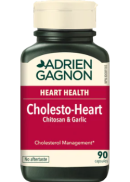
- 560 mg
- Chitosan (from shrimp)
- 25 mg
- Garlic [Allium sativum] (bulb) (20 :1 extract equivalent to 500 mg)
gelatin, magnesium stearate, maltodextrin.
Do not use this product if you have an allergy to seafood. Consult a health care practitioner, prior to use if you are pregnant or breastfeeding, if you are taking blood thinners or protease inhibitors, or if you have diabetes, or if symptoms persist or worsen. May cause abdominal pain, bloating, constipation, indigestion and/or diarrhea. Stop use if hypersensitivity /allergy occurs.
 Capsules
90 Caps
Adults: Take 1 capsule twice daily, with meals, two hours before or after taking other medications or natural health products since their absorption may be delayed.
- Helps to lower blood cholesterol
- Helps to reduce fat absorption
- Contains concentrated garlic extract without unpleasant smell
- Improves cardiovascular health
- Non-GMO, Dairy, Gluten, Sugar, Peanuts and Tree Nuts Free

Empowering Canadians with Natural Wellness for Over 75 Years
Adrien Gagnon is a Canadian Naturopath that has been formulating natural health products for over 70 years. Adrien Gagnon supports many health concerns including; Energy with Super Energex, Women’s health with formulations like Feminex Meno Relief & Healthy Legs for varicose veins, Joint health with Glucosamine & Collagen Type 2, and overall health with vitamins and minerals such as calcium, magnesium and zinc, plus many more. They’re constantly finding innovative ways to offer top quality supplements with the best natural ingredients. Read more >- Reviews
- POST A NEW REVIEW
HIGH CHOLESTEROL
By: Articles by a Naturopathic Doctor and a Holistic Nutritionist
Controlling high cholesterol can be a challenge, but with the right nutritional supplements many people have success...
Despite the hype, cholesterol is actually not all bad; it is the amount and the ratio of the certain forms of cholesterol that are a health concern. Low-density lipoprotein (LDL cholesterol) is commonly called “bad” cholesterol, while high-density lipoprotein (HDL cholesterol) is commonly referred to as “good” cholesterol. Interestingly, it is not the type of cholesterol that is important, so much as the balance of “good” vs. “bad”.
Cholesterol is an essential molecule in our bodies. Our body cells use cholesterol to support their cell membranes and some of the membrane-associated receptor molecules. Cholesterol is also used to make steroid hormones in the body. Some examples of steroid hormones are reproductive hormones such as estrogen, progesterone, testosterone, and the stress hormone cortisol. Because of this, it is essential to keep cholesterol in balance in the body.
Blood Cycle
Cholesterol cycles from the liver to the body cells, and back again, via the blood. LDL cholesterol consists of fats that are being transported from the liver for use by your cells. HDL cholesterol consists of fat that is taking unused (excess) cholesterol from your cells back to the liver, where it is excreted. Because of this, high levels of LDL are not a big concern, so long as there are sufficient levels of HDL to retrieve any excess cholesterol left behind in the body. Thus, cholesterol levels are unhealthy if you have excess circulating LDL, insufficient HDL, or a combination of the two. Cholesterol that is left in the rest of the body and not retrieved by sufficient HDL can build up inside the arteries and when combined with systemic inflammation, can cause cardiovascular disease. Thus, maintaining cholesterol balance, or a good cholesterol ratio on your blood work is actually more important than targeting LDL cholesterol directly. Supplementing fish oil is an excellent way to boost your HDL cholesterol. For more information, please see our Fish Oil article.
Cardiovascular Disease
high cholesterol contributes to cardiovascular disease, also known as heart disease, which is the number one cause of death in North Americans. High cholesterol causes a buildup of molecules inside of arteries that narrows the arteries and erases the elasticity and flexibility of the artery walls. The body responds to this narrowed space by increasing blood pressure to ensure adequate blood flow to all tissues. This is referred to as high blood pressure. When pieces of the cholesterol plaque break off, they can cause a change in the blood flow which leads to clots; clots and cholesterol plaque can and do end up causing heart attacks and strokes. For more information, please see our Cardiovascular Health article.
Cholesterol Cycle
Interestingly, the liver not only synthesizes cholesterol, it is also responsible for excreting any excess. It does this by mixing it in with the bile, and releasing it into the digestive tract. This cholesterol in the gut gets mixed with any food and is bound by any soluble fibre present. For more information on its cholesterol-binding capability, please see our Fiber article. Once it is bound, the cholesterol is shed with the stool. Unfortunately, any unbound cholesterol in the gut is free to be reabsorbed by the body and to again cycle in the bloodstream.
Back to Top ↑