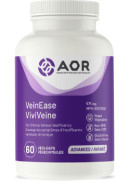
- 900mg
- Diosmin (non-synthetic)
- 100mg
- Hesperidin (from Citrus aurantium fruit)
- 150mg
- Vitis vinifera L (Grape Seed) extract (≥85% oligomeric proanthocyanidins)
Contains no wheat, gluten, corn, nuts, peanuts, sesame seeds, sulphites, mustard, soy, dairy, eggs, fish, shellfish or any animal by product. Consult a health care practitioner prior to use if you are pregnant or breastfeeding, if you are taking any recommendation medications, for use beyond three months or if symptoms persist or worsen.
 Veggie Caps
60 V-caps
Take one capsule twice daily with/without food, or as directed by a qualified health care practitioner. Use for a minimum of one month to see beneficial effects.
- Chronic Venous Insufficiency (CVI)
- Varicose Veins
- Antioxidant
- Maintenance of good health
- Reduces swelling, tingling and heaviness in legs

Innovative Formulas by AOR Canada found at National Nutrition
AOR Canada is the innovative formulators of Canada’s best-selling antioxidant support, AOR Advanced B Complex and AOR Tri-B12. They are also known for their top bone health supplements, Ortho Adapt and Bone Basics. You can also SHOP AOR's Nattokinase, and trusted Curcumin Ultra, Curcumin Active and Curcumin95 inflammation support at National Nutrition.ca. AOR are leaders in natural health with innovative product development. Read more >- Reviews
- POST A NEW REVIEW
Reviews By Rating
helpful votes
6
6 customers found this product review helpful
What is CVI?
Chronic Venous Insufficiency (CVI) is a weakening of the walls or valves of veins that bring used blood back to the heart. CVI occurs most commonly in the leg because the legs are far from the heart and the blood returning from the legs must work hard against gravity to get back to the heart. Inactivity or long periods of sitting can also cause blood pooling in the legs because muscle contractions help pump blood back from the legs to the heart.
Venous insufficiency can occur in the superficial veins or in the deep veins. Most varicose veins are related to superficial venous insufficiency that usually begins in high-pressure areas either at the top of the thigh and produces a varicose vein growing downward or in the calf and growing upward. Deep venous insufficiency is much more serious since the primary cause is a blood clot (deep venous thromboembolism, DVT), and half of DVT patients end up with a pulmonary embolism (blood clot in the lungs), where morbidity jumps to 1 in 3 cases. However, even just with superficial CVI the risk of DVT is 3 times higher, so it’s important to manage even minor CVI properly.
Anatomy of the Venous System
Blood in the arteries gets pushed through the body by the forceful pumping of the heart; since there is no risk of backflow, arteries do not need valves. The blood flows from the larger arteries into arterioles, smaller vessels, and then capillaries, which are tiny vessels that allow the exchange of oxygen, CO2, nutrients and cellular waste products between the tissues and the bloodstream. This exchange process happens by diffusion.
The used blood then flows into venules and then veins, through which the blood returns to the heart to be reoxygenated. At this point, there is very little pumping force from the heart pushing the blood through the veins. In addition, venous blood generally has to work against gravity, moving up from the limbs to get back to the heart. So since there is little pumping force moving the blood, and since the force of gravity is strong, how does the blood get back to the heart?
Moving Muscles Pump Blood
The pumping force does help a little. However, muscle contractions from leg movement contribute quite a bit to this process. That’s why some people experience swelling of the legs after long periods of sitting, or why others might faint after a hard workout if they don’t cool down properly by continuing to move rather than just stopping cold-turkey.
Veins Need One-Way Valves
The little, if any, force from the heart and the force of muscle contractions aren’t enough to keep the blood moving against gravity and toward the heart. Therefore, veins have one-way valves that stop blood from flowing back down the extremities with gravity in between pumps. If any of the three pumping mechanisms fail (heart pumping, muscle contractions and one-way valves), blood may begin to pool in the legs.
What Causes CVI?
CVI can result from genetic weakness of the vein walls, from hormonal changes during pregnancy, or from damage to the valves. Other factors that can contribute to CVI include a sedentary lifestyle, low blood pressure or high blood pressure. Venous walls are not as elastic as arteries, so when high blood pressure constantly applies outward force against the walls of the veins, the veins become distended or stretched. This stretching changes the shape of the veins and makes it impossible for the valves to close properly, allowing blood to flow backward, or venous reflux. Venous reflux is associated with more severe CVI.
Progression of CVI
The first symptom of superficial CVI is usually varicose veins, which are veins that are enlarged, contorted and very visible. When there is enough pressure in the veins from the excessive volume of blood, plasma can leak out of the vein into the surrounding tissues, causing swelling or edema of the leg. If this goes on long enough, it can produce skin ulcerations which are resistant to healing, and can be itchy or painful. Outward pressure on the veins and stretching of the valves is one theory.
Another theory on the progression of CVI is that tissues surrounding the veins and even the inner lining (endothelium) of the veins themselves become oxygen-deprived. This leads to increased blood vessel permeability and an inflammatory response that can cause adhesion sites to develop on the inner lining of the veins where leukocytes can attach themselves and secrete even more inflammatory factors; this damages the vessel lining. Fibrin also often accumulates. All of these inflammatory factors, when leached out of the vessels into the surrounding tissues, can damage the tissues, causing damage to the fat layer under the skin, or the skin itself, producing itchy or painful lesions.
Treatment Options
Grape seed extract has traditionally been used in herbal medicine to help treat varicose veins and CVI. Surgical removal and laser therapy are now available as treatment options for such symptoms. However, good success has been found using a natural flavonoid combination treatment including diosmin and hesperidin. The combination of 90% diosmin and 10% hesperidin at a dose of 1000 mg per day is well studied and proven to be very effective in helping with the symptoms of CVI likely by decreasing inflammation and strengthening the blood vessel wall structure. Diosmin, a flavonoid glycoside, can be naturally extracted from plants or derived from Hesperidin, a flavonoid. Hesperidin can be found in citrus rinds.
Grape seed extract for CVI
VeinEase is unique in that it combines the clinically tested combination of diosmin and hesperidin with grape seed extract, which is traditionally used in herbal medicine to help treat CVI. Grape seed extract is an antioxidant, protecting vessels from injury and from the furthering of CVI complications. It may also help maintain a healthy blood pressure and reduce edema. Since the presence of skin ulcers is directly proportional to venous pressure, improving venous blood pressure may help reduce skin ulcers.
One study administered 100 mg a of grape seed extract per day and found symptom improvements in 80% of subjects in as little as 10 days, including itching, heaviness, pain, and edema. Itching disappeared in 80% of patients. Pain disappeared in 53% of patients.
Safety and Toxicity
Animal studies showed no toxicity after 26 weeks of supplementation of a mixture of 90% diosmin and 10% hesperidin with doses of 35 times that recommended.
A mixture of diosmin and hesperidin taken by pregnant and nursing women for hemorrhoids did not affect fetus. However, consulting a health care professionnel in pregnancy and nursing is still recommended.
Diosmin may inhibit CYP 450 (phase I enzymes), so be careful in taking this product with drugs. No adverse events with blood thinning medications have occurred, but diosmin does have a slight blood thinning effect.
Back to Top ↑