

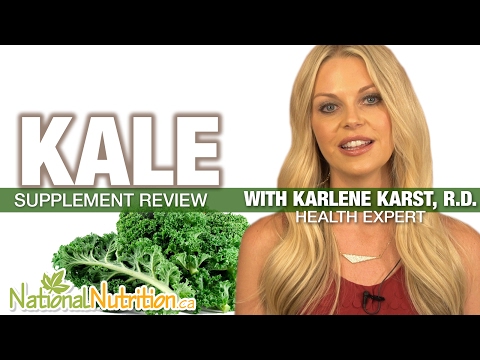
Kale
Updated Apr. 18th, 2024 | Read Time: 3 Minutes | What You Will Learn:
- What is Kale?
- Top Health Benefits of Kale
- Understand How Kale Supports Your Nutritional Needs
- Adding Vegetables To Your Daily Routine
- Nutritional Information
- Reader Comments (4)
Kale is arguably the world’s healthiest vegetable. This curly-leafed veggie has received a great deal of press lately and can be found in smoothies, raw juices, salads and even baked chips. Why all the hype? This nutritional powerhouse contains vitamins, minerals and antioxidants, osteoporosis and reduces overall inflammation and oxidative stress. One cup of kale has only 35 calories, 5 grams of fibre and more iron than beef per calorie!
What is Kale?
Kale is a member of the Brassica family of vegetables and is a sister to cabbage, broccoli, cauliflower, collards and brussel sprouts.
You’ll recognize it by its curly leaves and beautiful dark green colour. It is a rich source of vitamins K, C and A, as well as iron, calcium and magnesium. This vegetable is considered one of the healthiest vegetables around because it supplies so many nutrients and antioxidants in very few calories, making it incredibly nutrient-dense. The key to a healthy diet is eating nutrient-dense foods as often as possible.
Top Health Benefits of Kale
Kale has a long history as a culinary staple in cultures all over the world, but more recently has gained popularity in North America. Kale has become the new spinach and you’ll find it as the secret, health-boosting ingredient in green smoothies and raw juices because of its many health benefits. It is antioxidant-rich, making it an important food for preventing cancer and chronic inflammation. It also enhances detoxification, reduces cholesterol and prevents osteoporosis.
Understand How Kale Supports Your Nutritional Needs
First of all, kale is a green leafy vegetable and surely you’ve heard that increasing green leafy veggies in your diet is good for you. Buy why? Green leafy veggies contain antioxidants. The deeper the colour, the more antioxidants it contains. This vegetable is unique because it has a high amount of two powerful types of antioxidants, carotenoids and flavonoids. These antioxidants have been shown to reduce oxidative stress and chronic inflammation. Kale is also a rich source of glucosinolates such as indole-3-carbinol and sulforaphane, which have well-documented cancer-preventative properties and promote detoxification through the liver. Since this is a good source of vitamin K, it prevents osteoporosis because vitamin K helps attract calcium to bone tissue, making bones stronger and healthier.
Interestingly, there have been some research studies to show that kale is very effective at reducing cholesterol levels and is even comparable to some cholesterol-lowering medications. It’s important to note that steamed kale has significantly better cholesterol-lowering effects than raw.
Adding Vegetables To Your Daily Routine
Kale is easy to use. Look for produce with firm, deeply coloured leaves and moist hardy stems. The leaves should look fresh and be free from wilting, yellowing, browning and holes. Choose smaller leaves for a more tender and mild taste. Store your produce in the fridge, unwashed in a plastic bag with most of the air removed and it will last up to 5 days. Kale becomes bitter the longer it is stored, so be sure to use it. You can easily add a handful or two of the de-stemmed leaves to a smoothie and you won’t even notice the taste but will see your smoothie transform into a beautiful green colour. If you have a juicer, you can juice kale leaves and stems and it tastes great with juiced cucumber, celery and apples. Kale can also be used in salads, baked as chips and tastes great steamed.













Depuis bientôt 10 ans, mon épouse et moi, faisant partie du groupe d'âge des +65 ans, utilisons un breuvage à base de 'Kale'. C'est une poudre que nous dissolvons dans un peu d'eau et que nous ingurgitons quotidiennement le matin, l'après-midi et le soir. Nous constatons que ce breuvage améliore notre santé générale et nous redonne un équilibre. Nous avons grandement réduit notre consommation de viandes et nous en portons bien, en ayant ajouté plus de légumes et fruits à notre régime alimentaire.
For almost 10 years, my wife and I, part of the 65+ age group, have been using a drink made from 'Kale'. It is a powder that we dissolve in a little water and that we swallow daily in the morning, afternoon and evening. We find that this drink improves our general health and gives us a balance. We have greatly reduced our consumption of meats and are doing well by adding more vegetables and fruits to our diet.
Bonjour Jean Marie,
C'est excellent à entendre! Les poudres vertes sont d'excellents moyens d'obtenir des nutriments et d'améliorer votre santé. Les poudres antioxydantes sont également idéales pour ajouter à l'eau et ajouter à votre routine quotidienne. Lisez également notre article pour en savoir plus sur les antioxydants.
https://www.nationalnutrition.ca/articles/supplements/antioxidants/
Rester bien!
Your article reminds me of why I am so very grateful to be in America's heart (or rather coastal soul <3) of agriculture, California!! I love going to the Farmer;s Market during the weekend to pick up local kale. It's been so large, lovely, and green this season (looks like summer is kicking in!). I love the taste and I love how it nourishes my body as well-thank you for the reminder on particular facts-I didn't realize kale had more iron than beef per calorie, for example!
Hello Rachel,
Indeed, kale offers a nutritional punch and is loaded with minerals and nutrients like iron! This is a great plant-based way to get more iron for anyone, but particularly those that are vegetarian and vegan. Being able to get fresh, organic kale at your local farmer's market is excellent and very fortunate.
Have a healthy day