

Vitamin K: Essential for Bone Health
Understanding Vitamin K: A Key Nutrient for Bone and Blood Health
Vitamin K is probably one of the lesser-known vitamins, or more precisely, groups of vitamins since research has identified at least 12 forms. Danish scientists discovered Vitamin K rather haphazardly in 1929 as part of sterol metabolism experiments, and it was immediately associated with blood coagulation, hence its name "koagulation" in Danish. Read more >-
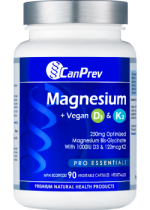
CanPrev’s Magnesium + Vegan D3 & K2 is a heart-friendly formula to help maintain strong bones and is formulated with a extra-gentle magnesium-glycine complex. Magnesium. It’s essential in over 800 different enzymatic functions in your body, from DNA synthesis and energy production to proper muscle function, including the heart. This proprietary extra gentle Magnesium + Vegan D3 & K2 complex fr...
+ Earn 24 Reward PointsSale: $24.99
Reg.: $27.99 (Save $3.00)
In Stock
The Crucial Role of Vitamin K in Strengthening Bone Health
Vitamin K is probably one of the lesser-known vitamins, or more precisely, groups of vitamins since research has identified at least 12 forms. Danish scientists discovered Vitamin K rather haphazardly in 1929 as part of sterol metabolism experiments, and it was immediately associated with blood coagulation, hence its name "koagulation" in Danish. Only recently has the scientific community become aware of the incredibly diverse and far-reaching benefits that Vitamin K compounds offer beyond blood clotting and cardiovascular health. Indeed, one of the most impressive properties of vitamin K is its ability to regulate calcium deposition in the body, essentially ensuring that calcium is directed into bones and teeth rather than accumulating in soft tissues such as the blood vessels and kidneys.
This is why, in the last decade or so, vitamin K has been added to many bone health supplements and protocols to promote bone formation and remodelling as well as accelerate bone tissue repair across the lifespan. Vitamin K may be especially beneficial for women as they enter perimenopause (roughly ages 35 to 50) and postmenopause to help prevent the loss of bone mineral density and guard against osteoporosis.
Moreover, because vitamin K has been shown to play an essential role in improving cerebral blood flow, studies have shown it can also help bolster brain health and cognition and slow cognitive decline associated with aging.
Comprehensive Benefits of Vitamin K for Stronger Bones and Overall Wellness
- Boosts Brain Function
- Helps Prevent Osteoporosis
- Promotes Healthy Bone Formation And Maintenance
- Protects Cardiovascular and Circulatory Health
- Strengthens Bones
Identifying Who Benefits Most from Vitamin K Supplementation
A quality vitamin K supplement may be recommended to women aged 35 and beyond to promote optimal musculoskeletal health and help maintain healthy bone mineral density well into old age. Healthcare practitioners may also recommend a vitamin K supplement to men and women to help reduce the risk of heart disease, arterial calcification, and cardiovascular-associated mortality.
Those who do not adhere to a healthy and varied diet and individuals with poor appetites may be especially prone to deficiency and benefit from supplementation.
Vitamin K: Potency, Forms, and Formats
Vitamin K supplements typically come in either K1 or K2 forms. The former (K1) phylloquinone is found primarily in plant foods like leafy green vegetables and makes up roughly 75–90% of all the vitamin K we consume. Vitamin K2, on the other hand, is found in fermented foods and animal products and is also produced by gut bacteria. Vitamin K2 is distributed throughout the body, whereas vitamin K1 is absorbed by the liver, which is why K2 is widely considered the more desirable form. Several K2 or menaquinones (MKs) subtypes exist, from MK-4 to MK-13, with MK-7 and MK-4 being the most prized and researched.
Vitamin K supplements come in capsules (gelatin-based or veggie), gummies, softgels, liquids, and liposomal blends for enhanced absorption. They come in a range of potencies, which vary according to their intended use.
Concluding Insights: Maximizing Health Benefits with Vitamin K
Unlike other fat-soluble vitamins, vitamin K is broken down quickly and excreted via urine or stool, so it does not tend to reach toxic levels in the body, even with high intakes. However, like other soluble vitamins, vitamin K should be taken with a fat-containing meal or snack to boost absorption and reap the most health benefits.
A vitamin K supplement should not be taken with blood-thinning medications unless otherwise advised by your treating physician.
Back to Top ↑








