- 134mg
- Pancreatic Enzymes (Sus scrofa - Pancreas) 11 x USP(alpha-Amylase 36850 USP AU, Pancrelipase 2948 USP LU, Protease 36850 USP PU)
- (1800000 FCC PU) 50 mg
- Bromelain (Ananas comosus var. comosus-Stem)
- (120000 FCC PU) 60 mg
- Papain (Carica papaya - Fruit)
- (1200 FCC HUT) 2.4 mg
- Protease (Aspergillus flavus var. oryzae-Whole)
- (120 FCC CU) 0.8 mg
- Cellulase (Trichoderma reesei-Whole)
- 200 mg
- Betaine hydrochloride (Beta vulgaris - Root)
- 100 mg
- Ox (Bos taurus - Bile) (Cholic Acid 45%)
- 30 mg
- Ginger (Zingiber officinale - Rhizome) (10:1, QCE 300 mg)
- 20 mg
- Fenugreek (Trigonella foenum-graecum - Seed)(20:1, QCE 400 mg)
- 1 Billion CFU
- Lactobacillus acidophilus (Whole Cell, LA-14)
Hypromellose (capsule ingredient), Microcrystalline cellulose, Colloidal silicon dioxide, Magnesium stearate (vegetable source), Gellan gum
Sealed for your protection. Do not use if safety seal is broken or missing. Keep out of the reach of children. For freshness store in a cool, dry place. See below for cautions & warnings.
 Veggie Caps
210 V-caps
Adults: 1 capsule 2-3 times per day. Swallow whole/do not crush or chew. Take with or immediately before a meal/food. Use the smallest effective dose which controls symptoms. Take at least 2-3 hours before or after antibiotics.
- Decrease bloating
- Help relieve digestive upset including lack of appetite, nausea, digestive spasms, indigestion, dyspepsia, and flatulent colic carminative
- Helps support intestinal/gastrointestinal health
- 1 Billion CFU per capsule
- With delayed release pancreatin
- Contains no added gluten, nuts, eggs, fish or shellfish, soy, corn, wheat

Premium Quality & Canadian Made - 12 New Added
Founded in 1991, Naka’s success has been built upon introducing innovative supplements in liquid or easy-to-swallow capsule forms designed to meet the better health needs of consumers worldwide. Their most popular supplements include: Naka Pro Collagen, Naka Vital Greens, Naka Magnesium Bisglycinate, Naka Nutri Flex, Naka Vital Greens and Naka Probiotics.You can find Naka herbs and buy Naka supplements at NationalNutrition.ca Read more >- Reviews
- POST A NEW REVIEW
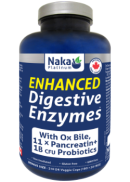
NAKA PLATINUM ENHANCED DIGESTIVE ENZYMES:
Cautions & Warnings: Consult a health care practitioner if symptoms persist or worsen. Consult a health care practitioner health care provider prior to use if you have an allergy to latex or fruits (e.g. avocado, banana, chestnut, passion fruit, fig, melon, mango, kiwi, pineapple, peach, and tomato). Consult a health care practitioner prior to use are taking an anticoagulant/blood thinner or anti-inflammatory medications. Consult a health care practitioner prior to use if you are pregnant, breastfeeding, have diabetes, pancreatitis, pancreatic exocrine insufficiency or cystic fibrosis. Consult a health care practitioner prior to use if you are taking anticoagulant agents, anti-inflammatory agents, or antibiotics. Consult a health care practitioner prior to use if you are having a surgery. Consult a health care practitioner prior to use if you have a peptic ulcer or excess stomach acid. Consult a health care practitioner prior to use if you have fever, vomiting, bloody diarrhoea or severe abdominal pain. Stop use and consult a health care practitioner if symptoms of digestive upset (e.g. diarrhea) occur, worsen and/or persists beyond 3 days. Consult a health care practitioner prior to use if you have diabetes. Do not use this product if you are sensitive to pancreatic enzymes. Do not use this product if you are sensitive to pork proteins. Do not use this product if you have an immune-compromised condition (e.g. AIDS, lymphoma, patients undergoing long-term corticosteroid treatment). Do not use if you suffer from gastric reflux or if you have gastrointestinal lesions/ulcers. Do not use if you have liver, gastrointestinal tract or gallbladder disorders, and/or bowl obstruction. Do not use if you have gallstones or a bile duct obstruction. Stop use if hypersensitivity/allergy occurs. Stop use and consult a health care practitioner if nausea, vomiting, abdominal pain/epigastric pain and/or heartburn occur. Some people may experience gastrointestinal discomfort/disturbances.
WHAT ARE ENZYMES?
Enzymes are catalysts of chemical reactions. This means that they initiate and increase the rate of one or several body processes. Without enzymes, reactions in the body would take place too slowly to maintain life. Digestive enzymes are responsible for breaking down food particles so that they can be absorbed in the intestinal tract and either used for energy or stored for later use.
There are three main categories of digestive enzymes, amylase, protease and lipase. Amylase enzymes digest sugars, for example, like milk sugar is digested by lactase and cane sugar by sucrase. Amylase is found in saliva, pancreatic juice and intestinal juice. Proteases are responsible for breaking down protein. It is found in intestinal and pancreatic juice. Lipases digest fat and are released in the stomach and intestines.
You Can Support Digestive Health By:
- Chewing food completely.
- Eating several small meals daily instead of three large meals.
- Avoiding fluids with meals.
- Eating a variety of fresh fruits and vegetables.
- Avoiding refined, processed foods.
- Not overeating; eat until 80% full.
- Taking a HCL supplement before meals.
- Supplementing with Probiotics.
- Taking digestive enzyme during or after meals.
INTESTINAL HEALTH
The intestine is the main absorptive area of the digestive tract. It is essentially a tube with a thin mucosal lining and lots of blood vessels on the inside and muscles around the outside. It has its own immune tissue called GALT, or gut associated lymphoid tissue. The inner lining is filled with little fingers, or projection of the mucosa, which greatly increases its absorptive surface.
Lying on the membrane are many friendly organisms, which help our body with the digestive process. The small intestine attaches to the stomach. Near it’s beginning, ducts from the liver and pancreas release digestive juices. These juices mix with the partially digested food from the stomach and continue the digestive process. Nutrients are absorbed through the thin intestinal wall and transported via the bloodstream, to where they are needed. The liver also excretes processed toxins and fats through the bile. These substances must be carried through the intestine without being absorbed.
The remainder of the food is pushed through into the large intestine. The main function of the large intestine is the preparation of stool for excretion. In order to do this the digested food must be dehydrated and compacted. The last bit of nutrients may also be absorbed here.
Some of the most important players in intestinal health are not part of our own body. Friendly intestinal bacteria, often called probiotics, are an essential part of digestion. They break down food particles, manufacture vitamins and prevent the infection of the tract with other microbes. Each bowel movement actually contains millions of these friendly bacteria; they are in a constant state of renewal. Many concerns like indigestion, gas, bloating and constipation can be due to an imbalance of the intestinal bacteria. It is easy to upset this balance by improper diet or taking medications like antibiotics.
Back to Top ↑