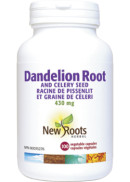
Each vcap contains:
- 323 mg
- Dandelion (Taraxacum officinale) root
- 107 mg
- Celery (Apium graveolens var. dulce) seed
Non-Medicinal Ingredients:
Vegetable magnesium stearate in a non‑GMO vegetable capsule composed of vegetable carbohydrate gum and purified water.
Vegetable magnesium stearate in a non‑GMO vegetable capsule composed of vegetable carbohydrate gum and purified water.
Important Information:
Free of all common allergens, including: wheat, dairy, eggs, corn, soy, and yeast.
Format
 Veggie Caps
100 V-caps
Dosage
Take 3 capsules three times daily, preferably with food.
Product Information:
- Stimulates detoxification of the liver and kidneys
- Natural diuretic properties
- Stimulates bile production
- Helps to cleanse the urinary tract
- Convenient capsule form

Proudly Manufactured In Canada & Available National Nutrition.
New Roots Herbal offers high-quality natural health products like their best-selling probiotics, digestive enzymes, chill pills, strong bones, acidophilus ultra and black cumin seed oil among hundreds more herbal remedies. Founded in 1985 New Roots Canada delivers formulas that were designed to address health imbalances and support the body's natural healing processes and overall well-being. You can buy all New Roots supplements at National Nutrition.ca Read more >What People Are Saying:
- Reviews
- POST A NEW REVIEW
Reviews for:
Dandelion Root + Celery Seed 430mg - 100 V-Caps
(1 review)
Reviews By Rating
helpful votes
1
1 customers found this product review helpful
More Info
Dandelion Celery
The combination of dandelion root and celery in this formula exerts several restorative and detoxifying elements to improve hepatic health. The carotenoid content of dandelion root is 25% more than that found in carrots. The carotenoids, phytosterols, tannins and vitamins A and C cleanse the bloodstream and liver and stimulate bile production.
The essential oils and vitamins in celery seed have restorative and regenerative qualities that improve liver function to reap the benefits of better joint mobility and skin quality that go hand in hand with a healthy liver.
Dandelion
It's hard to believe that the "weed" that many of us try to prevent from making its home on our lawn is such an important medicinal herb. Dandelion roots are used for digestive disorders because it stimulates the release of bile, which helps the body to digest fats.
It may also help to regulate cholesterol levels. The release of bile also flushes the gallbladder and liver of processed toxins, making dandelion an excellent liver cleanser.
Dandelion roots and leaves have a bitter taste that stimulates the release of saliva and stomach acid, thus increasing appetite. Dandelion leaves act as a potassium-sparing diuretic that compares favorably to some recommendation diuretics in studies. Dandelion leaf can be used to treat water retention such as retention that is due to PMS. Dandelion leaf also flushes fluid through the kidneys and is a good herb for cleansing the urinary tract. Dandelion has some antimicrobial properties that make it useful for infections like abscesses and boils.
Dandelion leaf and root can be used as encapsulated herb, dried herb, tincture or liquid extract. The roots contain the liver and digestion supporting medicinal substances while the leaf contains the kidney and urinary tract supporting substances. Dandelion root is found as a component of many intestinal and liver cleansing formulas. In order to help with digestion, bitter herbs must be tasted, like when you take in a tincture or tea. Encapsulated herbs are swallowed, thus bypassing the taste buds, and will not stimulate digestion. Dandelion leaf is found as a component of kidney cleansing formulas.
Dandelion is in the same plant family as ragweed therefore individuals with ragweed allergies should not use dandelion. Also, prolonged use of dandelion may lead to sensitization to ragweed. Dandelion's diuretic properties may upset the fluid balance of individuals taking diuretic medication, lithium or digoxin. Dandelion stimulates intestinal and gallbladder contractions and the release of digestive juices therefore it is contraindicated for use by people with gallbladder conditions, intestinal obstruction, stomach inflammation and irritable bowel syndrome.
Celery
The use of celery as medicine dates back centuries. Hippocrates believed it calmed the nerves, and as far back as 30 AD, they were using celery to relieve pain. Today, celery seeds are often labeled as a blood purifier, helping to support the kidney and bladder function, and subsequently the elimination of toxins through urine.
Celery is a mild diuretic, often used to decrease uric acid levels in the body, treating gout. It is also commonly used to relieve inflammation caused by rheumatoid and osteoarthritis. Celery juice is also well known for its ability to lower blood pressure.
Celery is commonly recommended for weight loss, as it is low in calories (almost no calories), while higher in dietary fibre. It is also a good source of minerals like calcium, sodium, and chlorine. It is used used to reduce acidity and restore electrolytes in the body, because of this. There is some research to suggest that celery may be beneficial in psoriasis (with caution), as certain constituents have been shown to increase photosensitivity under UV radiation.
Allergy to celery is quite common and can be severe enough to cause an anaphylactic reaction. Cooking does not decrease the allergic potential of this plant, which contains an allergen which closely resembles birch pollen.
Celery seed extract is available in capsule form and is often included in gout, blood pressure and circulation formulas. There is no proven effective dose for celery extract in adults. Consult your healthcare provider to determine which dosage is right for you. Celery is considered safe in food amounts. Individuals taking celery based supplements or high celery content in diet, need to use caution if also taking medication to lower blood pressure, including diuretics, as well as blood thinning medication due to possible additive effects. Celery ingestion or contact with essential oils can increase photosensitivity. Subsequent UV radiation exposure has been known to cause phytodermatitis.
The combination of dandelion root and celery in this formula exerts several restorative and detoxifying elements to improve hepatic health. The carotenoid content of dandelion root is 25% more than that found in carrots. The carotenoids, phytosterols, tannins and vitamins A and C cleanse the bloodstream and liver and stimulate bile production.
The essential oils and vitamins in celery seed have restorative and regenerative qualities that improve liver function to reap the benefits of better joint mobility and skin quality that go hand in hand with a healthy liver.
Dandelion
It's hard to believe that the "weed" that many of us try to prevent from making its home on our lawn is such an important medicinal herb. Dandelion roots are used for digestive disorders because it stimulates the release of bile, which helps the body to digest fats.
It may also help to regulate cholesterol levels. The release of bile also flushes the gallbladder and liver of processed toxins, making dandelion an excellent liver cleanser.
Dandelion roots and leaves have a bitter taste that stimulates the release of saliva and stomach acid, thus increasing appetite. Dandelion leaves act as a potassium-sparing diuretic that compares favorably to some recommendation diuretics in studies. Dandelion leaf can be used to treat water retention such as retention that is due to PMS. Dandelion leaf also flushes fluid through the kidneys and is a good herb for cleansing the urinary tract. Dandelion has some antimicrobial properties that make it useful for infections like abscesses and boils.
Dandelion leaf and root can be used as encapsulated herb, dried herb, tincture or liquid extract. The roots contain the liver and digestion supporting medicinal substances while the leaf contains the kidney and urinary tract supporting substances. Dandelion root is found as a component of many intestinal and liver cleansing formulas. In order to help with digestion, bitter herbs must be tasted, like when you take in a tincture or tea. Encapsulated herbs are swallowed, thus bypassing the taste buds, and will not stimulate digestion. Dandelion leaf is found as a component of kidney cleansing formulas.
Dandelion is in the same plant family as ragweed therefore individuals with ragweed allergies should not use dandelion. Also, prolonged use of dandelion may lead to sensitization to ragweed. Dandelion's diuretic properties may upset the fluid balance of individuals taking diuretic medication, lithium or digoxin. Dandelion stimulates intestinal and gallbladder contractions and the release of digestive juices therefore it is contraindicated for use by people with gallbladder conditions, intestinal obstruction, stomach inflammation and irritable bowel syndrome.
Celery
The use of celery as medicine dates back centuries. Hippocrates believed it calmed the nerves, and as far back as 30 AD, they were using celery to relieve pain. Today, celery seeds are often labeled as a blood purifier, helping to support the kidney and bladder function, and subsequently the elimination of toxins through urine.
Celery is a mild diuretic, often used to decrease uric acid levels in the body, treating gout. It is also commonly used to relieve inflammation caused by rheumatoid and osteoarthritis. Celery juice is also well known for its ability to lower blood pressure.
Celery is commonly recommended for weight loss, as it is low in calories (almost no calories), while higher in dietary fibre. It is also a good source of minerals like calcium, sodium, and chlorine. It is used used to reduce acidity and restore electrolytes in the body, because of this. There is some research to suggest that celery may be beneficial in psoriasis (with caution), as certain constituents have been shown to increase photosensitivity under UV radiation.
Allergy to celery is quite common and can be severe enough to cause an anaphylactic reaction. Cooking does not decrease the allergic potential of this plant, which contains an allergen which closely resembles birch pollen.
Celery seed extract is available in capsule form and is often included in gout, blood pressure and circulation formulas. There is no proven effective dose for celery extract in adults. Consult your healthcare provider to determine which dosage is right for you. Celery is considered safe in food amounts. Individuals taking celery based supplements or high celery content in diet, need to use caution if also taking medication to lower blood pressure, including diuretics, as well as blood thinning medication due to possible additive effects. Celery ingestion or contact with essential oils can increase photosensitivity. Subsequent UV radiation exposure has been known to cause phytodermatitis.
Back to Top ↑