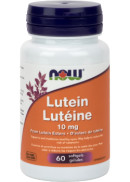
- 10mg
- Lutein (free lutein)
- 116mg
- (From Lutein Esters (marigold flower tagetes erecta)
Contact health care practitioner prior to use if you are pregnant or breastfeeding. Do not use if allergic to the Asteraceae/Compositae/Daisy family
 Softgels
60 Softgels
Take 1 softgel daily with meals.
- May reduce the risk of cataracts
- Supports Eye Health
- Supports Macular Health
- Powerful Antioxidant
- A Dietary Supplement

- Reviews
- POST A NEW REVIEW
Reviews By Rating
helpful votes
0
0 customers found this product review helpful
Taking Care of Your Eyes
The best time to start taking care of your eyes is before a problem even starts. While the progressive loss of vision from the degeneration of the macula does not usually appear until after age forty, the damage to the eye actually begins long before. It begins slowly as damage to individual cells, which after time affects tissues on a larger scale, ultimately resulting in the advanced vision impairment characteristic of this disorder.
The earlier you begin intervening against this damage with antioxidants, the better.
Macular degeneration is the leading cause of visual loss in North America. It is caused by free radical damage to the macula, the area of the retina responsible for central vision. Blurring in the centre of the visual field eventually makes detail work and reading impossible. The periphery of the visual field remains unaltered. Thus a kind of reverse tunnel vision results.
Macular degeneration is caused by free radical damage and tends to occur as we age; hence it is often called “age-related macular degeneration” or AMD. Free radicals are unstable molecules that in their bid to become more stable must bump into healthy cells and cause damage. Unhealthy food, poor quality water, toxins, and ultraviolet radiation from the sun are the major contributors of free radicals that build up in the eye. Other contributors to macular degeneration are hypertension and arteriosclerosis, both of which can restrict blood flow to the macula.
What results are two different types of macular degeneration. The first and most common type consists of free radical damage to the light sensitive cells of the macula. The second less common type occurs when blood vessels of the eye become fragile and break largely due to free radical damage, but also because of an increase in pressure against the blood vessel wall from hardening of the arteries and high blood pressure. The blood flow crucial to maintaining the health of the macula is then reduced. Both result in the same loss of sight in the centre of the eye’s field of vision and can affect only one eye or both eyes at once. People can have on or the other type of AMD, or in fact a combination of the two together.
Free radical damage to light receptor sites of the macula can be slowed and even stopped completely with the right nutritional supplements. The most important supplement to use for reducing the oxidative damage to these cells is the carotenoid lutein.
Derived in a supplemental form from marigold flowers and related to beta carotene, lutein has an affinity for the tissues that make up the macula. So, when you take lutein, it protects the macula specifically, while other antioxidants, although useful, are used throughout the whole body.
An analogy that researchers often use to describe this effect is that it is similar to applying a high SPF suntan lotion to your skin to prevent sunburn. A second carotenoid, zeaxanthin, also has a affinity for the macula of the eye and is often included in lutein supplements.
Free Radical and Lutein
Free radicals are unstable molecules that in their bid to become more stable must bump into healthy cells and cause damage. Beta-carotene can help in cell growths, which can result from free radicals damaging cellular genetic material. It also protects the body against environmental pollutants other substances that and lead to aging. Lycopene is a carotenoid that functions as an antioxidant for the prostate gland and lowers the risk of prostate tumors.
Xanthophylls are another subgroup of carotenoids. They include lutein and zeaxanthin. Lutein and zeaxanthin work in the eye as antioxidants. Cataracts are caused by free radical damage of the lens of the eye and therefore lutein and zeaxanthin can treat cataracts. Studies show that they also protect the eye from damage and can reduce the incidence of eye disease such as macular degeneration.
Lutein
Lutein and zeaxanthin are both different isomers of the same xanthophyll pigment molecule. They are naturally occurring carotenoids found in highest abundance in green leafy vegetables. Both of these molecules play a large role in EYE HEALTH. They are both found to be highly concentrated in the retina, which is the lining on the back of the eye that is responsible for vision.
Like with many other carotenoids, any lutein and zeaxanthin that is not used for immediate bodily requirements is able to act as an antioxidant to reduce free radical damage to the tissues.
Eye Health
Lutein and zeaxanthin are responsible for the ability of our eyes to absorb blue light, which is a wavelength of light that produces free radicals and puts significant oxidative stress on tissues. Studies show a correlation between high lutein consumption and increased pigmentation of the retina. Increased pigment has been shown to lower your risk of macular degeneration and cataracts, although it doesn't reverse already established illnesses. Interestingly, lutein is found in highest concentration in the peripheral retina, which better senses motion and black-and-white. Zeaxanthin, on the other hand, is found to be highly concentrated in the macula, the more detail and colour-sensitive region of the retina. Lutein may also prove helpful for retinopathies associated with advanced diabetes likely from protection against damage from excess sugar in the blood.
Other Benefits
High lutein consumption has been associated with a reduced incidence of prostate cell growths in men. It may also help prevent or slow down the thickening of the arteries known as atherosclerosis, which is a major risk for cardiovascular disease. Interestingly, cardiovascular disease is often accelerated by free radical damage.
How can I get lutein and zeaxanthin?
Eating a diet rich in green leafy vegetables like spinach, kale and collard greens is a great way to increase your lutein and zeaxanthin intake. As a supplement, lutein comes individually in capsules, or as a sublingual spray for those with compromised digestion. Both lutein and zeaxanthin can be found in a number of combination formulas for eye health. There is currently no recommended dosage for lutein or zeaxanthin. Many supplements commonly suggest between 6-12mg/day of lutein and 2-6mg/day of zeaxanthin. It is advisable to follow the recommended dosage provided by each manufacturer.
Important Information
Lutein and zeaxanthin are non-toxic, but can cause harmless yellow-orange skin pigmentation if consumed in very large amounts.
Back to Top ↑