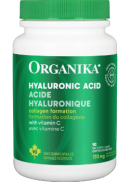
- 120mg
- Hyaluronic acid (Streptococcus equi, Bacterial extracellular capsule)
- 90mg
- Vitamin C (Ascorbic acid)
Brown rice, Magnesium Stearate, Hypromellose (Vegetarian capsule)
Keep out of the reach of children. Sealed for your protection. Do not accept product if safety seal is broken. Keep container tightly closed. Store in a cool, dry place to preserve freshness. Consult a health care practitioner prior to use if you are pregnant or breastfeeding. Consult a health care practitioner if symptoms worsen.
 Veggie Caps
90 V-caps
Take 1 capsule once per day.
- Helps in collagen formation
- Supports bone and joint health
- Lubrication of joints
- Full-body tissue hydration
- Animal-origin free for a safer, purer, and more sustainable product
- Free from dairy, egg, yeast, wheat, corn, gluten, soya or GMO

Nourishment Rooted in Nature - 12 New Added
Organika, formulators of Canada’s best-selling Collagen and marine collagen and Bone Broth supports skin and joint health. Organika's health products also include; Organika spirulina, Chlorella, Curcumin to support inflammation, Organika Enhanced Collagen Protein, and Adaptogens to provide balance. Shop Organika here at National Nutrition.ca for quality, Canadian-made supplements. Read more >- Reviews
- POST A NEW REVIEW
HA (HYALURONIC AICD)
By: Articles by a Naturopathic Doctor and a Holistic Nutritionist
Hyaluronic acid plumps up our skin to prevent wrinkles, cushions our joints, and stimulates wound healing. Not too bad for a substance formerly known as “goo” …
We all know that our bodies are made up of an incredibly large number of cells (current estimates are in the 10 trillions), but have you ever wondered what holds all of those cells together, and fills in the gaps between them? This extracellular “glue” is called the matrix (no Neo here though sci-fi fans). It turns out that a large percentage of the extracellular matrix is made up of molecules called hyaluronic acid (HA).
What Is Hyaluronic Acid (HA)?
HA is a glycosaminoglycan, which means it is an extremely large chain of sugar molecules linked together. When HA is in the presence of water, it forms what early researchers described as “goo” (sounds wonderful, no?). This “goo” is what fills in the gaps between our cells and makes our bodies soft and squishy to the touch. It is the ability of HA to draw water into the tissues that keep us hydrated and maintains skin turgor (resilience). It thickens some fluids in our body and softens most tissues. More recent research has found that HA also provides a framework (like roads) for immune cells to travel along and climb through as they migrate through the tissues. HA is found in high concentrations in many tissues in the body, including: skin, cartilage, and the fluid inside the eye.
Wrinkles And Skin Aging
The tissue below the outer layer of skin is packed with HA. This glycosaminoglycan draws water into the tissues and keeps them plump. When there is not enough HA or water present, the tissue below the skin loses thickness, and as a result, the skin will sag and wrinkle. Thus, a simple way to combat the visible signs of aging is to support healthy HA synthesis in the skin, and to keep it well hydrated with sufficient water to promote plumping out of deeper wrinkles, and reduction of fine lines. In fact, HA is commonly injected by medical doctors and plastic surgeons to directly plump up wrinkles and lines in the face. These are the injections marketed as “fillers” like Restylane. For more information, please see our Aging Skincare article.
Protecting The Skin
HA has recently been established as the primary free radical scavenger in the skin, and potentially in the rest of the body as well. Free radicals are unstable molecules with an unpaired electron that are extremely reactive, and damage surrounding cell membranes, fats, and fat-soluble vitamins and nutrients. We encounter free radicals through environmental exposures, such as cigarette smoke, air pollution, processed foods, and ultraviolet radiation from the sun (UV rays). The damage caused by free radicals can result in cell death, alterations in genetic material and autoimmune reactions to damaged cells. It has been found that in sunburned skin, HA becomes degraded in large amounts and later this was found to be because it absorbed much of the UV radiation. Thus, HA helps to protect the skin against free radical damage from the sun, at its own expense. HA also holds other antioxidants in the skin, like vitamin A, so they can further protect against damage.
Wound Healing And Skin Inflammation
Because a large number of our tissues are made up of HA saturated with water, and so when they become damaged HA plays a leading role in healing. When an injury first occurs, HA synthesis nearby increases to help promote immune cell migration to the area. Dry skin conditions caused by allergic Dermatitis can often be treated using a lotion containing high concentrations of HA. Application of HA to wounds can help to trigger faster healing, particularly in tissues already rich in HA, such as the eye. Because of this, HA can be applied to wounds, burns, as well as skin and mouth ulcers to help speed their healing.
Joint Health
The cartilage that makes up the lining of the joint surfaces contains HA, which helps to provide elasticity and flexibility. HA is also found in the fluid that cushions our joints and prevents friction within the joint capsule. Supplementation with HA can significantly help to support healthy joint surfaces and joint function. For more information, please see our Joint Health article. Some medical doctors will provide HA injections directly into joints affected by osteoarthritis to help reduce symptoms. Research has shown that the cartilage in joints with osteoarthritis does not contain sufficient HA. For more information, please see our Arthritis (Osteo) article.
How Can I Get HA?
The human body naturally produces HA in its tissues. HA can also be extracted from rooster combs as an animal source. HA used for supplementation is synthesized by bacteria in a laboratory. A diet rich in root vegetables and green leafy veggies can act as an excellent source of HA. Some examples are: potatoes, carrots, sweet potatoes, kale, and spinach. Eat these raw as much as possible to preserve the heat-sensitive HA. For supplementing HA there is currently no established dose in the research, but it is commonly recommended at 200mg, twice daily. Topical creams and gels tend to contain 2.5% HA and can be applied to the skin as the manufacturer suggests.
Hyaluronic Acid- Quick Facts
Sources
· Potatoes, Carrots, Sweet Potatoes, Kale, And Spinach. Bacterial Synthesis Or Rooster Comb.
Applications
· Osteoarthritis, Skin Ulcers, Burns, Wounds, Anti-Aging Skincare, Joint Health
Optimum Dosage
· 200 Mg Twice Daily. (Clinical Doses May Differ As Recommended By Your Practitioner).
Works Well With
· Vitamin A, Vitamin C, Msm, Glucosamine, Vitamin E
Important Information
· There Is No Toxicity, Side Effects Or Contraindications For The Use Of Hyaluronic Acid At This Time.
· Injections Should Only Be Performed By A Trained Medical Professional.
Back to Top ↑