

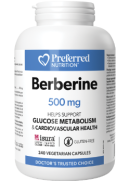
- 500mg
- Berberine (hydrocholride) (Berberis vulgaris) (root bark)
Vegetarian capsule (cellulose, purified water), microcrystalline cellulose, vegetable grade magnesium stearate (lubricant), silica, stearic acid
Always consult a health care professional before taking a supplement. Keep out of reach of children.
 Veggie Caps
240 V-caps
Take 1 capsule 2 times daily with meals or as directed by a health care practitioner.
- Helps maintain cardiovascular health
- Supports Triglyceride Levels
- Supports Cholesterol Levels
- Supports Blood Sugar Levels
- May Help With Blood Pressure, Healthy Weight, And Advance Immune Function
- Non-GMO, gluten free, and vegetarian friendly

Wellness made simple with Preferred Nutrition at National Nutrition
Preferred Nutrition makes quality natural health supplements to support your overall health needs. Top products include: MagSense for muscle pain, NEM for joint health, Saw Palmetto Plus Vitex to support hormone balance, Stress B to naturally support stress and UTI drops to help infections naturally. Read more >- Reviews
- POST A NEW REVIEW
BERBERINE
A constituent of herbal remedies that kills microbes, improves cardiovascular health, and prevents diabetes...
Berberines are a particular type of constituent found in a number of different plants that gives them a yellow colour. The most well known of which are: Barberry (Berberine vulgaris), Oregon grape (Mahonia aquifolium), and Goldenseal (Hydrastis canadensis). These herbs have been used for over 2,500 years around the world to treat a variety of different health concerns. Traditionally, berberine was used as an antibiotic to treat bacterial, viral, parasite and Candida (yeast) infections. Current research has noted a number of benefits of berberines in the treatment of: diabetes, Alzheimer's, depression, and cardiovascular disease.
Herbs Containing Berberines
There are quite a few herbs that contain large amounts of berberines. The most commonly known of those are listed below:
Barberry
This herb has been used around the world for centuries to treat infections and diarrhea. Recent research has also found that it benefits the cardiovascular and nervous systems (brain and nerves).
Goldenseal
This natural antibiotic is one of the richest known sources of berberines. It has long been established as a mucous membrane tonic and is actually known in the herbal community as the "king of the mucous membranes".
Oregon Grape
The root of this shrub has been used for hundreds of years to help treat diarrhea. It is particularly useful in treating multi-drug resistant bacterial infections. It can also be applied topically in a cream to help treat psoriasis.
Phellodendron amurense
Recent research has shown that P. amurense contains berberines. It is this constituent that researchers believe gives the herb its ability to inhibit lung tumour growth.
Antimicrobial Activity
Berberines have been used for their antimicrobial activity for centuries, and much of their traditional use stems from this capability. Recent research has shown berberines to have antimicrobial activity against a large variety of organisms including: bacteria, viruses, fungi, and parasites. They also have antimicrobial activity against MRSA and can prevent their ability to stick to the epithelial cells and thus prevent MRSA from invading the body and causing infection. Berberines can also potentiate current antibiotics to allow them to once again be able to kill MRSA by bypassing their resistance ability. In addition to this, berberines are strongly active against Gram positive bacteria like: Staphylococcus, Streptococcus, Enterococcus, and Clostridium. All of these are bacteria that are frequent causes of infection, particularly in hospitals. Berberines also shows inhibitory effects on the growth and reproduction of certain microorganisms and viruses, such as Heliobacter pylori and hepatitis B virus. There is also some evidence that berberines can help to eliminate Candida (yeast) infections.
Antioxidant
Berberines are extremely strong antioxidants that can inhibit the generation of reactive oxidative species (ROS). Because of their extremely strong antioxidant abilities, they can help to protect cells against the damage, and protect the blood vessels against cardiovascular disease. It is also this effect that helps berberines to combat Alzheimer's disease.
Cardiovascular Health
Berberine's strong antioxidant ability helps it to protect LDL ("bad") cholesterol from being oxidized, which is one of the strongest contributing factors to the formation of atherosclerosis. Recent evidence suggests that berberine has beneficial effects on dyslipidemia (imbalanced blood fats and cholesterol) as well. By promoting a healthier cholesterol and blood fat profile, berberines can help to reduce the risk of cardiovascular disease.
Diabetic
The anti-diabetic affect of berberines has been well established by research. Some interesting new research (2011) has found that this benefit may be due to the berberines helping to regulate the gut microbes and prevent inflammation. Interestingly, this implies that diabetes may be partially caused by an inflammatory state in the body. This is a relatively new way of viewing the origin of type II diabetes and has triggered a new direction for research.
Leaky Gut
Much of the earliest research on berberines surrounded their use for the treatment of diarrhea. This was also one of the original traditional folk uses in history. These compounds have been shown to help reduce immune-mediated damage of the endothelial tight junctions in the gut. This helps to restore the gut barrier function and reduce the symptoms of leaky gut.
Protects The Brain And Mental Health
Berberine has been established as beneficial in the treatment of a number of central nervous system disorders. It has the ability to protect neurons, and prevent their death, while improving circulation to the brain. Research has shown a protective effect in Alzheimer's, cerebral ischemia, mental depression, schizophrenia and anxiety.
How Can I Take Berberines?
Berberines can be found in a number of different herbs, and the dosing for each can be found in their individual articles. When dosing berberines directly, the dose is not yet completely established, although current evidence suggests 500mg twice a day.
Berberines – Quick Facts
Parts Used
· Berberines Can Be Found In A Number Of Herbs Such As: Goldenseal, Oregon Grape, Barberry And P. Amurense.
Applications
· Diarrhea, Leaky Gut, Cardiovascular Health, Diabetes, Infection, Multi-Drug Resistant Bacteria, Yeast Infection
Optimum Dosage
· 500mg Twice Daily Of Berberines When Supplemented Directly. (Clinical Doses May Be Higher As Recommended By Your Practitioner).
Works Well With
· L-Glutamine, Antioxidants, Echinacea
Important Information
· Berberines Are Not Safe For Use During Pregnancy Or While Breast-Feeding. Use Should Also Be Avoided In Children Under The Age Of 5.
· Berberines May Lower Blood Sugar Levels, And Diabetics And Those With Hypoglycemia Should Use With Caution. It Also Lowers Blood Pressure, So Those Taking Blood Pressure Medications Should Use Caution.
· Berberine May Increase The Blood Concentration Of Cyclosporine And Should Not Be Used With This Medication.
Back to Top ↑
-

Sale: $8.99
Reg.: $12.99 (Save $4.00)
-

Niacin Flush-Free 500mg - 120 Caps
Sale: $32.99
Reg.: $39.99 (Save $7.00)
-

Sale: $7.69
Reg.: $8.75 (Save $1.06)












