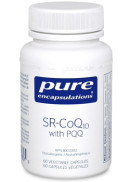
- 50 mg
- Coenzyme Q10 (from MicroActive® Q10-beta cyclodextrin complex, bacterial fermentation)
- 8.8 mg
- BioPQQ® Pyrroloquinoline quinone (from pyrroloquinoline quinone disodium salt)
Potato starch, Hypo-allergenic plant cellulose, Hydroxypropyl methylcellulose, Purified water.
Consult a healthcare practitioner prior to use if you are taking blood pressure or blood thinning medications.
 Veggie Caps
60 V-caps
Adults: Take 1 capsule twice daily with food. Consult a healthcare practitioner for use beyond 12 weeks.
- Supports cardiovascular health
- Promotes romotes antioxidant defence
- Helps improve memory & concentration
- Anti-Inflammatory Properties
- Essential For Overall Health

Quality Vitamins Trusted by Healthcare Professionals
Pure Encapsulations offers hypoallergenic natural health supplements that undergo third-party testing for purity and potency. Pure Encapsulations is a leading brand among healthcare practitioners and is free from gluten, GMO, fillers and preservatives. Top-selling vitamins and minerals include; Magnesium Glycinate and B-Complex Plus. With Pure Encapsulations you have quality assurance. Read more >- Reviews
- POST A NEW REVIEW
PURE ENCAPSULATIONS SR-COQ10 WITH PQQ
Provides 24-hour sustained release MicroActive® CoQ10 with BioPQQ®
- Supports cardiovascular health
- Promotes antioxidant defence
MicroActive® CoQ10 is a water-soluble, submicron particle-sized CoQ10 generated through a patented process that complexes each CoQ10 molecule with a beta-cyclodextrin molecule. CoQ10 is bound to the lipophilic end of the molecule, while the other end is hydrophilic, facilitating dispersion and transport. At the cellular surface, the complex dissociates, liberating a single CoQ10 molecule for efficient absorption. Clinical research indicates superior absorption compared to solubilized and crystalline CoQ10, with low inter-subject variance. The actions of CoQ10 are particularly supportive of tissues that require a lot of energy, such as the heart muscle. CoQ10 provides multifunctional support for cardiovascular health through different mechanisms, including mitochondrial and antioxidant support. Research indicates that CoQ10supports heart muscle function and healthy cellular oxygen utilization by promoting energy production as a core component of cellular respiration. Furthermore, it acts as an antioxidant, providing protection from free radicals and helping to maintain the integrity of cellular membranes. PQQ (pyrroloquinoline quinone) is a novel redox cofactor naturally present in vegetables and in the human body, including breast milk. BioPQQ® is manufactured in Japan using a patented natural fermentation process, and has been studied in numerous mechanistic investigations as well as a recent double-blind, placebo-controlled trial.
BioPQQ® is a trademark of MGC (Japan)
BRAIN HEALTH & CONCENTRATION
Optimizing levels of amino acids and essential fats can help you produce more neurotransmitters which help you to concentrate... without coffee or stimulants.
Easy Ways to Boost Your Brain Health and Concentration... Naturally!The brain is a complex organ. Very generally speaking, the brain receives sensory information from the body, analyzes the 'data' and then responds accordingly, whether it be a motor response, or autonomic function, such as breathing or controlling heart rate. The brain does it all and without it, we simply do not function. So how do we keep this vital organ in tip top shape? In order for the brain to function optimally, at any age, it requires healthy nerve cells, and an adequate supply of blood, nutrients and neurotransmitters. Read on to find out how we can best supply this vital organ with all it needs.
Brain Basics
The human brain consists of a number of different sections which are all responsible for a slightly different functions. The brain stem, which attaches the brain to the spinal cord, is responsible for some reflexes and autonomic functions, such as breathing, heart rate, and blood pressure. The cerebellum, located posterior and inferior, is responsible for position and movement. The hypothalamic and pituitary area, the innermost portion of the brain, is responsible for visceral functions, such as regulating body temperature, sexual response, aggression and pleasure, feeding and drinking. The cerebral cortex is the hub of the brain, the main processing station. Here, almost all the information entering the brain from sensory organs is integrated and processed. Motor function is initiated, emotion and thought processes are controlled and memory is stored. The cortex has the ability to sort out the information it receives and send it out to the specific lobe responsible for the task. The frontal lobe, for instance is in charge of motor skills, including speech, as well as overseeing executive functions/higher order functions, such as self control, planning, reasoning and abstract thought. The occipital lobe processes visual information, while the temporal lobe's main function is to process auditory information. The parietal lobes process touch, pain and temperature (somatosensory information). Wernicke's area is also found here, responsible for the understanding of written and spoken language.
How Your Brain Communicates With You and Your Body
The brain, including all of these lobes, make up one portion of the Central Nervous System (CNS). The spinal cord and peripheral nerves, along with the brain are the key components of this system. The brain is made up of a vast number of nerve cells (neurons), through which electrochemical signals are transmitted. This is how messages are sent within the central nervous system. These messages can travel long distances jumping from one nerve cell to another (across synapses), or a short distance down one single neuron. Not all signals or messages need to travel to the brain in order for a response to be generated. Many reflexes, for example, are messages that enter the spinal cord through a sensory neuron, meet with a motor neuron, which then sends a message to the appropriate muscle (usually to contract.). More complex processes require information to be sent to the brain's cerebral cortex where it is processed and sent on. These signals travel extremely quickly and rely on a healthy environment to function optimally.
Brain Health For Everyone
Even young, healthy individuals can suffer from 'brain fog', or the odd memory lapse and even the happiest of people can have a 'slump', suffering from fluctuations in mood or bouts of depression. Alzheimer's and dementia, among other often debilitating diseases involving brain function, are certainly a cause for concern but we don't have to be suffering from one of these diseases in order to take precautions. There are things we can do now, at any age, to protect our healthy brains from deterioration and provide them with the nourishment and support they deserve. There are a number of different supplements, as well as lifestyle and dietary tips that can support sustained and healthy brain function.
Amino Acids, The Building Blocks of Neurotransmitters
Amino Acids found in protein are integral to the efficient and optimal functioning of the body. The brain requires these amino acids for optimal functioning, as well. Phenylalanine is an essential amino acid, meaning it must be taken in through diet. It can be found in a variety of meat, fish, seafood, seeds and lentils. One major function of phenylalanine is that is produces the non-essential amino acid Tyrosine. Tyrosine plays a role in a number of different brain related functions. Tyrosine is converted into the neurotransmitters epinephrine, norepinephrine and dopamine. These neurotransmitters support such processes as memory, attention and problem solving. They also help to combat depression, provide mood support and balance the overall stress response.
Glutamine is another amino acid with brain boosting abilities. Glutamine is the most abundant amino acid in the body, one of the reasons being that it acts as a secondary fuel source for the brain when glucose is not available, as such it provides energy to all the cells of the brain, making it vital to every function. Glutamine is considered both essential and non-essential, depending on the circumstances in the body. Seeing as it is so vital to the brain, as well as both immunological and gastrointestinal functioning, supplementing with glutamine, or at the very least making sure to consciously include it in the diet, is very important. Food sources of glutamine include animal protein, beets, cabbage, beans, raw spinach and parsley.
Back to Top ↑