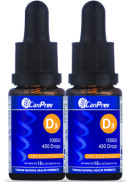
One drop contains :
- 1,000IU
- Vitamin D3
Non Medical ingredients:
Medium chain triglycerides, d-alpha tocopherol.
Medium chain triglycerides, d-alpha tocopherol.
Important Information:
GMO free. No gluten, dairy, wheat, yeast, sugar and artificial flavours or preservatives.
Format
 Liquid
15ml + 15ml
Dosage
Infants and older - Take 1 drop per day as directed by a health care practitioner.
Product Information:
- Each drop provides 1,000IU of vitamin D3
- Superior bioavailability compared to vitamin D2
- MCT oil base
- Easy to liquid form

Feeling Better Together - Found at National Nutrition
Support performance, recovery, and overall wellness with CanPrev’s premium amino acid formulas. L-Arginine promotes healthy blood flow and cardiovascular support, while L-Glutamine aids muscle recovery and gut health. L-Glycine supports collagen production and repair, and L-Lysine helps maintain skin, bone, and immune health. L-Taurine enhances endurance and hydration, while L-Tyrosine supports focus, mood, and thyroid function. Completing the range, MuscleRescue Precision Amino Acid Blend delivers a balanced spectrum of essential amino acids to optimize muscle growth, recovery, and performance, making CanPrev a top choice for high-quality amino acid supplementation. Read more >What People Are Saying:
- Reviews
- POST A NEW REVIEW
Reviews for:
D3 Drops 1,000iu - 15 + 15ml (2 For Deal)
(11 reviews)
Reviews By Rating
helpful votes
2
2 customers found this product review helpful
More Info
vitamin D
More and more doctors and Naturopaths are recommending that their patients boost their vitamin D supplements. Why? Because good recent research shows deficiencies are widespread, especially in the northern hemisphere where we don't get enough sun exposure for more than half the year!
Although at one time 400IU was considered appropriate for supplementation, many health care practitioners are now recommending 1000-4000IU/day, with doses as high as 10,000IU/day still being considered safe and necessary depending on the condition and assuming you are under the supervision of a healthcare provider.
It is fair to say that we are only just beginning to understand the immense difference that vitamin D can make in terms of everyday health and disease prevention.
Vitamin D plays an integral role in bone health, promoting our absorption of both calcium and phosphorus. For this reason, it is commonly used in the prevention and treatment of osteoporosis.
We are understanding more and more the importance that vitamin D is playing in supporting immune function. Vitamin D has the ability to modulate the immune response, rather than simply strengthen it. In cases of immune dysregulation (autoimmune disorders, psoriasis) it serves to balance the response, therefore decreasing the dangerous over-reaction to our own cells and tissues that is seen in many of these conditions. Research studying the use of vitamin D in influenza and various respiratory tract infections, has also showed some promising results. It is now considered one of the top supplements to use during cold and flu season to ward off the offending viruses and bacterium. Vitamin D deficiencies have been associated with an increased risk of influenza, as well as the common cold. The fat soluble vitamin has been shown to dramatically stimulate the expression of potent anti-microbial peptides, which exist in neutrophils, monocytes, natural killer cells, and in epithelial cells lining the respiratory tract. These cells play a major role in protecting the lung from infection.
Vitamin D has heart protective effects, as well. It has been shown to lower high blood pressure and is useful in the prevention of cardiovascular disease. Vitamin D is also being used in the management of Type II diabetes, as it has been shown to be involved in insulin secretion and glucose tolerance. Many mental disorders are now being correlated with vitamin D deficiency and supplementation is proving beneficial for many individuals suffering from depression, schizophrenia, seasonal effective disorder, manic/bipolar disorder and autism.
Vitamin D deficiency is considered less than 50 ng/ml of 25(OH)D, which is the active form of vitamin D in our bodies. Deficiency can occur with inadequate sun exposure, inadequate dietary intake, kidney or liver disease, and alcoholism. Elderly, dark-skinned, and obese populations, as well as those with fat malabsorption syndromes or inflammatory bowel disease, are also said to be at greater risk. Vitamin D deficiency causes rickets in children, leading to weak and deformed bones. In adults, deficiency can lead to osteomalacia, and osteoporosis, dental problems, muscle weakness and tooth decay.
When supplementing with Vitamin D, be sure to look for D3 (cholecalciferol) as it is significantly more efficient at raising 25(OH)D levels than the other form of D, D2 (ergocalciferol).
More and more doctors and Naturopaths are recommending that their patients boost their vitamin D supplements. Why? Because good recent research shows deficiencies are widespread, especially in the northern hemisphere where we don't get enough sun exposure for more than half the year!
Although at one time 400IU was considered appropriate for supplementation, many health care practitioners are now recommending 1000-4000IU/day, with doses as high as 10,000IU/day still being considered safe and necessary depending on the condition and assuming you are under the supervision of a healthcare provider.
It is fair to say that we are only just beginning to understand the immense difference that vitamin D can make in terms of everyday health and disease prevention.
Vitamin D plays an integral role in bone health, promoting our absorption of both calcium and phosphorus. For this reason, it is commonly used in the prevention and treatment of osteoporosis.
We are understanding more and more the importance that vitamin D is playing in supporting immune function. Vitamin D has the ability to modulate the immune response, rather than simply strengthen it. In cases of immune dysregulation (autoimmune disorders, psoriasis) it serves to balance the response, therefore decreasing the dangerous over-reaction to our own cells and tissues that is seen in many of these conditions. Research studying the use of vitamin D in influenza and various respiratory tract infections, has also showed some promising results. It is now considered one of the top supplements to use during cold and flu season to ward off the offending viruses and bacterium. Vitamin D deficiencies have been associated with an increased risk of influenza, as well as the common cold. The fat soluble vitamin has been shown to dramatically stimulate the expression of potent anti-microbial peptides, which exist in neutrophils, monocytes, natural killer cells, and in epithelial cells lining the respiratory tract. These cells play a major role in protecting the lung from infection.
Vitamin D has heart protective effects, as well. It has been shown to lower high blood pressure and is useful in the prevention of cardiovascular disease. Vitamin D is also being used in the management of Type II diabetes, as it has been shown to be involved in insulin secretion and glucose tolerance. Many mental disorders are now being correlated with vitamin D deficiency and supplementation is proving beneficial for many individuals suffering from depression, schizophrenia, seasonal effective disorder, manic/bipolar disorder and autism.
Vitamin D deficiency is considered less than 50 ng/ml of 25(OH)D, which is the active form of vitamin D in our bodies. Deficiency can occur with inadequate sun exposure, inadequate dietary intake, kidney or liver disease, and alcoholism. Elderly, dark-skinned, and obese populations, as well as those with fat malabsorption syndromes or inflammatory bowel disease, are also said to be at greater risk. Vitamin D deficiency causes rickets in children, leading to weak and deformed bones. In adults, deficiency can lead to osteomalacia, and osteoporosis, dental problems, muscle weakness and tooth decay.
When supplementing with Vitamin D, be sure to look for D3 (cholecalciferol) as it is significantly more efficient at raising 25(OH)D levels than the other form of D, D2 (ergocalciferol).
Back to Top ↑