

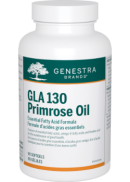
- 1300 mg
- Evening Primrose (Oenothera biennis) Seed Oil
- Yielding
- 130 mg
- GLA (Gamma-Linolenic Acid)
- 960 mg
- LA (Linoleic Acid)
- 70 mg
- OA (Oleic Acid)
- 78 mg
- PA (Palmitic Acid)
Gelatin, glycerin, purified water, d-alpha tocopheryl acetate
Guaranteed to contain no added wheat, starch, yeast, gluten, corn, sodium, sugar, artificial colouring or flavouring, antimicrobial preservatives or dairy products.
 Softgels
90 Caps
Adults: Take one capsule two times daily with meals, or as recommended by your health care practitioner.
- Essential fatty acids from evening primrose oil
- 130 mg Gamma-Linolenic Acid(GLA)
- 960 mg Linoleic Acid(LA) per capsule
- Purity guaranteed
- No artificial colours, flavours or preservatives

Evidence-Based Natural Health Supplements for Optimal Wellness
Genestra delivers professional-grade products that are offered in a variety of formats. Genestra natural health products have been proven safe, effective and reliable for over 30 years, and are backed by clinical evidence. Genestra brings you HMF Forte, HMF Immune, HMF UTI, Digest Plus, Probiotics, D-Mulsion and Super EFA Liquid. Read more >- Reviews
- POST A NEW REVIEW
Reviews By Rating
helpful votes
0
0 customers found this product review helpful
Borage is a plant with star shaped, periwinkle-blue flowers. The plant produces a dark, rich oil that contains valuable therapeutic lipids. The seed pod usually contains about 25% oil content.
The body is capable of naturally producing GLA. In order to do this, it must have its starting material, linoleic acid (LA). This is an essential fatty acid that the body is unable to make and must be ingested as part of the everyday diet. Fortunately, most people get plenty of LA in their daily diet, since it is commonly found in almost all edible vegetable oils.
Once LA is ingested, it is acted upon by an enzyme called delta-6-desaturase (D6D) which biochemically converts LA to GLA. This is how the body gets its daily fix of GLA.
Without the effective functioning of D6D, the body is unable to manufacture any GLA no matter how much LA is ingested. GLA is further converted via a sequence of biochemical steps into prostaglandin 1 (PGE1), a key molecule with numerous biological properties including:
- Anti-inflammatory.
- Dermatology (e.g. eczema).
- Anti-allergy.
- Nerve transmission.
- Secretion from the mucus membrane.
- PMS.
- Steroid production and hormone synthesis.
The first vegetable source of GLA was discovered in the oil of evening primrose seeds (where GLA content is 9%). This oil became well known with the public, health professionals, and in health stores. Then GLA was also discovered in borage and black current in higher amounts, 24% and 17% respectively. A 1992 study published in the journal 'Lipids' showed that "there was no significant difference in tissue GLA levels within groups given equal amounts of dietary GLA either in borage oil or evening primrose oil". In order to ingest 240mg of GLA, only 1 000mg of 24% borage oil needs to be taken compared to 2 660mg of EPO. Because reduced consumption of oil is desirable as a rule, the higher GLA potency of borage oil makes it preferable to evening primrose oil.
Clinical Studies
Anti-inflammatory
In rheumatoid arthritis (RA), benefit from non-steroidal anti-inflammatory drugs (NSAIDs) is mediated through inhibition of the cyclo-oxygenase enzyme, thereby decreasing production of the 2 series prostaglandins (PG2). The Lipoxygenase enzyme is intact, however, allowing leukotriene (LT) production; e.g. LTB4 is an inflammatory mediator. Treatment with GLA-240 leads to the production of the prostaglandin 1 series PGE1, which has less inflammatory effects. In addition, LT production is inhibited.
Post-viral fatigue syndrome
63 adult patients were treated with GLA for 3 months in a double-blind, placebo-controlled study. All patients had been ill for 1-3 years of a viral infection and were suffering from myalgia, severe fatigue and a variety of psychiatric symptoms. The essential fatty acid composition of the red cell membrane phospholipid improved significantly.
Mastalgia
414 patients with mastalgia were treated with Danazol, bromocriptine, or GLA. Danazol was the most effective, with GLA and bromocriptine having equivalent efficacy. However, many more adverse effects were noted with danazol and bromocriptine.
Diabetic neuropathy
A 1 year study observed 111 patients with mild diabetic neuropathy who were treated with 480mg of GLA per day and assessed for 16 parameters including tendon reflexes, muscle strength, hot and cold sensation etc. For all parameters, the changes were more favorable and statistically significant in the GLA group. The conclusion was that GLA had beneficial effects on the course of diabetic neuropathy.
Cautions - Possible interactions with phenothiazines (increasing seizure risk).
- May cause headaches and/or nausea.
- May increase bleeding time.
Back to Top ↑
-
Nourishing Mascara (Black Brown) - 11.5g
Sale: $11.19
Reg.: $13.99 (Save $2.80)
-

Mammoth Protein Bar (Chocolate Caramel) - 12 x 75g
Our Price: $47.88












