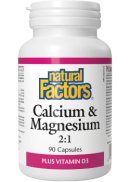
Each capsule contains:
- 250mg
- Calcium (Carbonate)
- 125mg
- Magnesium (Oxide)
- 100IU
- Vitamin D3 (Cholecalciferol)
Non-medicinal Ingredients:
Gelatin capsule (gelatin, purified water, titanium dioxide), microcrystalline cellulose, vegetable grade magnesium stearate (lubricant).
Gelatin capsule (gelatin, purified water, titanium dioxide), microcrystalline cellulose, vegetable grade magnesium stearate (lubricant).
Important Information:
Contains no artificial preservatives, color or sweeteners; no dairy, soy, wheat or yeast.
Format
 Capsules
90 Caps
Dosage
1-4 capsules daily or as directed by a health practitioner.
Product Information:
- Promotes strong bones and teeth
- Helps prevent osteoporosis
- With 100 IU Vitamin D3
- Protects against the effects of stress
- Aids in a restful sleep
- Supports healthy blood cells

Trusted Wellness For 60 Years, Sold at National Nutrition.
Based in British Columbia, Natural Factors Canada is one of the largest manufacturers of nutritional products in North America. Natural Factor Supplements origins reach back to the 1950s, & right from day one, they've been fully committed to making products right. Today, Natural Factors vitamins brings you tested and true products like Acidophilus and Bifidus, Ultimate Multi Probiotics, RX Omega-3, Theracurmin, PGX Daily, Whey Factors Protein and Oil of Oregano all of which you can BUY right here at National Nutrition.ca. Read more >What Customers Are Saying:
- Reviews
- POST A NEW REVIEW
More Info
Natural Factors Calcium & Magnesium Citrate With Vitamin D
Contains calcium and magnesium in a 2 to 1 ratio, a ratio recommended by many health care practitioners. The chelated form is tolerated better by those with allergies to citric products.
Calcium is required for strong bones, teeth and cardiac function. Calcium not only builds strong bones and teeth but maintains bone density and strength. It helps to regulate heartbeat, blood clotting and muscle contraction.
Calcium and magnesium are closely interconnected. Magnesium protects the body from stress, works with calcium in the same body systems, and participates in more than 50 different biochemical reactions. That's why magnesium is so important to bone formation, nerve and muscle transmission, and energy production.
Vitamin D is included because it acts as a hormone that allows the body to absorb and properly use calcium.
Calcium
Calcium is an important mineral for the optimal functioning of many body systems. Calcium is a major mineral found in the bones and teeth. Deficiency of calcium causes bone and joint diseases such as osteomalacia, osteoporosis and osteo-arthritis. It also leads to poor growth and poor bone density in children. Calcium also protects the body from heavy metal toxicity because if calcium is deficient lead is absorbed by the body and deposited in the teeth and bones.
The muscles use calcium during contractions and by the nerves for proper transmission of impulses. If a deficiency of calcium affects the most important muscle, the heart, it can lead to arrhythmias. Calcium also helps with insomnia and muscle cramps by relaxing the muscles. Calcium lowers cholesterol, by inhibiting plaque formation, and lowers blood pressure, by ensuring the proper functioning of the arterial muscles. Calcium is pulled out of the bones when the body becomes too acidic. This can occur due to the use of some medications, poor diet or when the body is in a state of inflammation, like rheumatoid arthritis or lupus. Calcium is involved at the level of the cell with the structure of the RNA and DNA molecules and the activation of enzymes for the use of fats. Calcium is commonly recommended by natural health care practitioners for osteoporosis, osteoarthritis, cardiovascular disease, PMS, pregnancy, nervous disorders, and insomnia.
Chelated or citrated calcium supplements are easier for the body to use and can be taken with or without food. Chelated simply means that calcium is bonded to a protein molecule, for example aspartate or glycinate, and citrated means that calcium is bonded to a citrate molecule. Both processes enhance calcium's absorption in the intestinal tract but decrease the amount of calcium that is available in one supplemental dose versus calcium carbonate. Calcium carbonate is the not the best calcium source because it must be taken with food for absorption. Additionally up to 40% of people over the age of sixty have chronic stomach inflammation that prevents the breakdown of calcium carbonate. Coral calcium is a form of calcium carbonate that has better absorption because it is a naturally occurring calcium and it is found in a complex with many other minerals. It is a good source for a variety of minerals and trace minerals.
Magnesium
Magnesium is an essential mineral for all known living organisms. Magnesium ions catalyze many chemical reactions in the human body, including those in the mitochondria where most of the energy inside each cell of the body is produced. It also plays a role in cell signalling within the body, with wound healing and with enzymes governing the replication of DNA.
Without magnesium, the transmission of nerve and muscle impulses is compromised. This can lead to nervous system disorders, muscle weakness or contraction, as well as cramps and spasms. For example, magnesium has been shown to decrease menstrual pain by relaxing the uterine muscles. Magnesium deficiency has also been strongly associated with depression, migraines, ADD, PMS, fibromyalgia, asthma, allergies and type II diabetes. Magnesium loss can be caused by some medications such as diuretics, antibiotics and some cell supporting drugs. Foods high in fat and oxalic acid interfere with the absorption of magnesium. Oxalic acid containing foods include almonds, chard, cocoa, rhubarb, spinach and black tea. Body requirements for magnesium increase with increased intake of zinc and vitamin D.
Vitamin D
Although at one time 400IU was considered appropriate for supplementation, many health care practitioners are now recommending 1000-4000IU/day, with doses as high as 10,000IU/day still being considered safe and necessary depending on the condition and assuming you are under the supervision of a healthcare provider.
It is fair to say that we are only just beginning to understand the immense difference that vitamin D can make in terms of everyday health and disease prevention.
Vitamin D plays an integral role in bone health, promoting our absorption of both calcium and phosphorus. For this reason, it is commonly used in the prevention and treatment of osteoporosis.
Additional Information
Children: Proper calcium intake is very important during childhood. Calcium supplements are suitable for children at dosages up to the RDA:
Infants - 0-0.5 year 400 mg, 0.5-1 year 600 mg
Children -1-3 years 800 mg, 4-6 years 800 mg, 7-10 years 800 mg
Magnesium is suitable for children at the level of the Recommended
Dietary Allowance:
Infants - 0-0.5 year 40 mg, 0.5-1 year 60 mg
Children - 1-3 years 80 mg, 4-6 years 120 mg, 7-10 years 170 mg
Pregnancy and Nursing
It is especially important for pregnant and lactating women to receive enough calcium. Calcium supplementation is considered safe during pregnancy and lactation at dosages up to the RDA.
Pregnancy 1,200 mg
Lactating 1,200 mg
Seniors: No special precautions for calcium or magnesium are known.
Contraindications
Aluminum-containing antacids are known to ultimately lead to an increase in bone breakdown and calcium excretion.The bone building drug etidronate (Didronel) and tetracycline antibiotics should not be taken within 2 hours of calcium supplements as the calcium may decrease their effectiveness. Calcium supplementation may also reduce the effectiveness of the following drugs: digoxin, gallium nitrate (Ganite), phenytoin (Dilantin). If you are taking any of these drugs, consult your health care practitioner before taking a calcium supplement.
Contains calcium and magnesium in a 2 to 1 ratio, a ratio recommended by many health care practitioners. The chelated form is tolerated better by those with allergies to citric products.
Calcium is required for strong bones, teeth and cardiac function. Calcium not only builds strong bones and teeth but maintains bone density and strength. It helps to regulate heartbeat, blood clotting and muscle contraction.
Calcium and magnesium are closely interconnected. Magnesium protects the body from stress, works with calcium in the same body systems, and participates in more than 50 different biochemical reactions. That's why magnesium is so important to bone formation, nerve and muscle transmission, and energy production.
Vitamin D is included because it acts as a hormone that allows the body to absorb and properly use calcium.
Calcium
Calcium is an important mineral for the optimal functioning of many body systems. Calcium is a major mineral found in the bones and teeth. Deficiency of calcium causes bone and joint diseases such as osteomalacia, osteoporosis and osteo-arthritis. It also leads to poor growth and poor bone density in children. Calcium also protects the body from heavy metal toxicity because if calcium is deficient lead is absorbed by the body and deposited in the teeth and bones.
The muscles use calcium during contractions and by the nerves for proper transmission of impulses. If a deficiency of calcium affects the most important muscle, the heart, it can lead to arrhythmias. Calcium also helps with insomnia and muscle cramps by relaxing the muscles. Calcium lowers cholesterol, by inhibiting plaque formation, and lowers blood pressure, by ensuring the proper functioning of the arterial muscles. Calcium is pulled out of the bones when the body becomes too acidic. This can occur due to the use of some medications, poor diet or when the body is in a state of inflammation, like rheumatoid arthritis or lupus. Calcium is involved at the level of the cell with the structure of the RNA and DNA molecules and the activation of enzymes for the use of fats. Calcium is commonly recommended by natural health care practitioners for osteoporosis, osteoarthritis, cardiovascular disease, PMS, pregnancy, nervous disorders, and insomnia.
Chelated or citrated calcium supplements are easier for the body to use and can be taken with or without food. Chelated simply means that calcium is bonded to a protein molecule, for example aspartate or glycinate, and citrated means that calcium is bonded to a citrate molecule. Both processes enhance calcium's absorption in the intestinal tract but decrease the amount of calcium that is available in one supplemental dose versus calcium carbonate. Calcium carbonate is the not the best calcium source because it must be taken with food for absorption. Additionally up to 40% of people over the age of sixty have chronic stomach inflammation that prevents the breakdown of calcium carbonate. Coral calcium is a form of calcium carbonate that has better absorption because it is a naturally occurring calcium and it is found in a complex with many other minerals. It is a good source for a variety of minerals and trace minerals.
Magnesium
Magnesium is an essential mineral for all known living organisms. Magnesium ions catalyze many chemical reactions in the human body, including those in the mitochondria where most of the energy inside each cell of the body is produced. It also plays a role in cell signalling within the body, with wound healing and with enzymes governing the replication of DNA.
Without magnesium, the transmission of nerve and muscle impulses is compromised. This can lead to nervous system disorders, muscle weakness or contraction, as well as cramps and spasms. For example, magnesium has been shown to decrease menstrual pain by relaxing the uterine muscles. Magnesium deficiency has also been strongly associated with depression, migraines, ADD, PMS, fibromyalgia, asthma, allergies and type II diabetes. Magnesium loss can be caused by some medications such as diuretics, antibiotics and some cell supporting drugs. Foods high in fat and oxalic acid interfere with the absorption of magnesium. Oxalic acid containing foods include almonds, chard, cocoa, rhubarb, spinach and black tea. Body requirements for magnesium increase with increased intake of zinc and vitamin D.
Vitamin D
Although at one time 400IU was considered appropriate for supplementation, many health care practitioners are now recommending 1000-4000IU/day, with doses as high as 10,000IU/day still being considered safe and necessary depending on the condition and assuming you are under the supervision of a healthcare provider.
It is fair to say that we are only just beginning to understand the immense difference that vitamin D can make in terms of everyday health and disease prevention.
Vitamin D plays an integral role in bone health, promoting our absorption of both calcium and phosphorus. For this reason, it is commonly used in the prevention and treatment of osteoporosis.
Additional Information
Children: Proper calcium intake is very important during childhood. Calcium supplements are suitable for children at dosages up to the RDA:
Infants - 0-0.5 year 400 mg, 0.5-1 year 600 mg
Children -1-3 years 800 mg, 4-6 years 800 mg, 7-10 years 800 mg
Magnesium is suitable for children at the level of the Recommended
Dietary Allowance:
Infants - 0-0.5 year 40 mg, 0.5-1 year 60 mg
Children - 1-3 years 80 mg, 4-6 years 120 mg, 7-10 years 170 mg
Pregnancy and Nursing
It is especially important for pregnant and lactating women to receive enough calcium. Calcium supplementation is considered safe during pregnancy and lactation at dosages up to the RDA.
Pregnancy 1,200 mg
Lactating 1,200 mg
Seniors: No special precautions for calcium or magnesium are known.
Contraindications
Aluminum-containing antacids are known to ultimately lead to an increase in bone breakdown and calcium excretion.The bone building drug etidronate (Didronel) and tetracycline antibiotics should not be taken within 2 hours of calcium supplements as the calcium may decrease their effectiveness. Calcium supplementation may also reduce the effectiveness of the following drugs: digoxin, gallium nitrate (Ganite), phenytoin (Dilantin). If you are taking any of these drugs, consult your health care practitioner before taking a calcium supplement.
Back to Top ↑