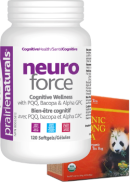
- 400mg
- Fish Oil (anchovy body oils)
- 250mg
- DHA
- 30mg
- EPA
- 75mg
- Bacopa extract (50% bacosides)
- 50mg
- Alpha-GPC
- 5mg
- Pyrroloquinoline quinone disodium salt
- 2.5mg
- Providing 4.63mg PQQ Vinpocetine
Free of all common allergens, including: wheat, dairy, eggs, corn, and yeast.
 Softgels
120 Softgels
Take 1 softgel daily with a meal, or as directed by a health care practitioner.
- Supports cognitive health
- Excellent source of omega-3 fatty acids
- 250mg of DHA for brain health
- Improves memory
- Helps prevent Alzheimer's disease

- Reviews
- POST A NEW REVIEW
Reviews By Rating
helpful votes
0
0 customers found this product review helpful
Brain Health For Everyone
Even young, healthy individuals can suffer from 'brain fog', or the odd memory lapse and even the happiest of people can have a 'slump', suffering from fluctuations in mood or bouts of depression. Alzheimer's and dementia, among other often debilitating diseases involving brain function, are certainly a cause for concern but we don't have to be suffering from one of these diseases in order to take precautions. There are things we can do now, at any age, to protect our healthy brains from deterioration and provide them with the nourishment and support they deserve. There are a number of different supplements, as well as lifestyle and dietary tips that can support sustained and healthy brain function.
Amino Acids, The Building Blocks of Neurotransmitters
Amino Acids found in protein are integral to the efficient and optimal functioning of the body. The brain requires these amino acids for optimal functioning, as well. Phenylalanine is an essential amino acid, meaning it must be taken in through diet. It can be found in a variety of meat, fish, seafood, seeds and lentils. One major function of phenylalanine is that is produces the non-essential amino acid Tyrosine. Tyrosine plays a role in a number of different brain related functions. Tyrosine is converted into the neurotransmitters epinephrine, norepinephrine and dopamine. These neurotransmitters support such processes as memory, attention and problem solving. They also help to combat depression, provide mood support and balance the overall stress response.
Glutamine is another amino acid with brain boosting abilities. Glutamine is the most abundant amino acid in the body, one of the reasons being that it acts as a secondary fuel source for the brain when glucose is not available, as such it provides energy to all the cells of the brain, making it vital to every function. Glutamine is considered both essential and non-essential, depending on the circumstances in the body. Seeing as it is so vital to the brain, as well as both immunological and gastrointestinal functioning, supplementing with glutamine, or at the very least making sure to consciously include it in the diet, is very important. Food sources of glutamine include animal protein, beets, cabbage, beans, raw spinach and parsley.
Just Like a Muscle: If You Don't use it, You'll Lose it.
Just as your body gets flabby and lazy without exercise, so does your brain. Both physical and mental exercise is extremely important to maintain healthy brain function. Physical exercise in the form of cardiovascular activity enhances blood flow to the brain, increasing the density and size of the brain capillaries. This increases oxygen to the brain and therefore optimizes delivery of nutrients and overall cognitive ability.
Crossword puzzles, games like Sodoku, card games, reading and learning new tasks, whether it be a new dance, a new song or a new language can all serve to increase brain function and enhance synapse activity within the brain. September means back to school for a lot of us, but it doesn't have to be a drag, just remember that with each new fact you learn or mathematical equation you solve, you are actually increasing brain power and protecting your brain from early decline. For those of us who have long finished school, remember that even old dogs can learn new tricks. Keep learning, it will keep your brain young and sharp.
Brain Health and Omega-3s
The brain requires the largest amounts of omega 3 fatty acids of the whole body. In fact, the brain is nearly 60% fat by weight, and a large percentage of this is DHA. Omega 3 fatty acids have also been shown to have an affinity for the central nervous system, helping to treat and prevent cognitive decline, protect memory, treat depression, bipolar disorder, attention deficit disorders and schizophrenia. DHA has been associated with improved brain function, while EPA is associated with mood balancing
Back to Top ↑