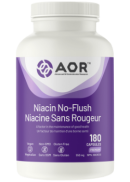
- 550 mg
- Inositol Hexanicotinate
- 500 mg
- Niacin (vitamin B3)
- 121 mg
- Inositol
Microcrystalline cellulose, sodium stearyl fumarate. Capsule: Hypromellose.
No serious adverse reactions to inositol hexanicotinate have been reported. However, some such reactions have been reported for conventional niacin, which cannot be absolutely ruled out at this time. It is recommended that regular liver enzyme tests be done in consultation with a physician.
 Capsules
180 Caps
Take one capsule daily with or without food, or as directed by a qualified health care practitioner
- Healthy Lipoprotein Balance.
- Circulation.
- Skin Health.
- Pharmaceutical Synthesis.
- 100% vegetarian.
Innovative Formulas by AOR Canada found at National Nutrition
AOR Canada is the innovative formulators of Canada’s best-selling antioxidant support, AOR Advanced B Complex and AOR Tri-B12. They are also known for their top bone health supplements, Ortho Adapt and Bone Basics. You can also SHOP AOR's Nattokinase, and trusted Curcumin Ultra, Curcumin Active and Curcumin95 inflammation support at National Nutrition.ca. AOR are leaders in natural health with innovative product development. Read more >- Reviews
- POST A NEW REVIEW
Niacin (nicotinic acid, a form of vitamin B3): is an important cellular mediator. Niacin is metabolized primarily in the liver to niacinamide, which is a raw materials to the two cellular coenzymes nicotine-adenine dinucleotide (NAD+) (and its high-energy form, NADH), and nicotine-adenine dinucleotide phosphate (NADP). These coenzymes are responsible for carrying out numerous reduction-oxidation (redox) reactions in the body, including their role in energy production in the mitochondria, and play a vital role in protecting and repairing DNA through the enzyme poly-ADP ribose polymerase (PARP).
Different Forms Of Niacin
The big problem with high-dose niacin supplementation is the niacin flush. Because it causes blood vessels to expand and release histamines (the immune factors responsible for some of the symptoms of allergies), higher-dose niacin causes warming and itching of the skin. The effect is a harmless - but some people find it absolutely maddening, and stop taking niacin altogether. Early attempts to solve this problem with a simple "sustained-release" niacin formulation called niacinamide eliminated the 'flush,' but caused a much more serious one: sustained-release niacin causes liver toxicity in a significant percentage of those taking it. To put this in context: while 39% of patients on regular niacin go off the supplement, mostly because of digestive problems and the "flush," 78% of those administered regular "sustained-release" niacin quit because of side effects, with 52% of them suffering liver toxicity!
By contrast, less than 1% of people supplementing their diets with high doses of regular niacin experience liver problems - a rate several times lower than that of patients taking statin drugs. Still, the potential of liver toxicity rightly gives many people pause.
While nicotinamide is sometimes mistakenly referred to as "flush-free niacin," niacinamide is actually not niacin at all, but a niacin metabolite, which lacks the key cholesterol-balancing and blood-vessel widening powers of niacin itself.
Inositol Hexanicotinate (IHN - also sometimes called inositol hexaniacinate) is the true "flushless niacin." Unlike "sustained-release" niacin, which is just regular niacin in a pill which dissolves more slowly, IHN is a niacin complex, formed with the B-vitamin-like inositol. When you take an IHN supplement, the central inositol ring gradually releases niacin molecules, one at a time - delivering true niacin, but in a controlled fashion governed by the kinetics of the hydrolysis of the molecule itself. This, like "sustained-release" niacin, allows you to take niacin at clinically-proven doses without going crazy with itch - but there is one big difference. While it's a good idea to have your liver enzymes tested while you're taking it, the fact is that no clinical trial has ever reported liver toxicity in persons supplementing with "flush-free" niacin. Regular monitoring of people taking doses as high as 4 000 mg of inositol hexanicotinate daily for four-month stretches has revealed no evidence of liver problems, or even changes in liver enzyme readings.
While only a few milligrams of niacin are needed each day to prevent a frank, life-threatening deficiency, studies clearly show that "megadose" niacin delivers remarkable heart-health benefits.
Cholesterol ... And Beyond
Niacin is the classic orthomolecule for supporting healthy cholesterol balance. Its use for this purpose goes back to the early 1950s, when Dr. Abram Hoffer, the "godfather" of the orthomolecular medical movement, happened to observe that the bleeding gums which he'd been experiencing disappeared while taking high-dose niacin. Hoffer realized that this observation might mean that niacin could have implications for atherosclerosis. A successful open trial was soon followed by more rigorous studies which proved Hoffer right beyond the shadow of a doubt.
For nearly 45 years, the improvements in cholesterol profiles in people supplementing their diets with niacin (typically in doses of 2 000 - 4 000 mg per day) have been confirmed again and again. Its greatest strengths are its powerful effects on boosting High-Density Lipoprotein (HDL, or "good" cholesterol) and in lowering triglycerides (TG). The result of this is that the ratio of TG to HDL is more improved by niacin than it is by statin drugs (like pravastatin (Pravachol) or atorvastatin (Lipitor) or by fibrates. For people with specific problems in these areas, the National Cholesterol Education Program (NCEP) has repeatedly announced niacin to be the treatment of choice. That's important, because a recent study found that the ratio of TG to HDL ratio is perhaps the most potent predictor of heart attacks we know: men whose ratios were in the highest 20% were a whopping sixteen times more likely to be in the group who had undergone a recent heart attack than those who had the lowest ratios!
Niacin is also the only proven way to reduce levels of lipoprotein(a) (Lp[a] - a little-known, but especially deadly lipoprotein. (One exception: estrogen therapy in menopausal women often restores lower Lp(a) levels).
Recently, for instance, a randomized, controlled comparison with lovastatin (Mevacor) found that niacin lowers LDL to a similar degree (23% (niacin) vs 32%(statin)), while elevating HDL considerably more (33% vs. 6%). And niacin lowers lipoprotein(a) (Lp[a]) by an astounding 35%, while lovastatin therapy has no effect.
But niacin doesn't just change the amount of cholesterol floating around in your blood: it also changes the biochemical composition of that cholesterol in heart-healthy directions. It's well-known that the LDL "bad" cholesterol is much more likely to form atherosclerotic plaques when it's been oxidized (damaged by free radicals). And the smaller and denser your LDL particles are, the more likely they are to become oxidized. Niacin converts the dense, easily-oxidized LDL particles to larger, more oxidation-proof ones. Likewise, the "good" cholesterol, HDL, is more effective at clearing cholesterol out of your cells when it's rich in a protein called apolipoprotein A-I. Niacin increases the concentration of apolipoprotein A-I in HDL, boosting its cholesterol-clearing powers.
There's more. Independently of its effects on cholesterol, niacin also lowers fibrinogen. Fibrinogen, a protein produced in the liver, is a necessary part of the normal blood clotting process. But when fibrinogen levels get too high - as can happen in conditions of inflammation - fibrinogen can increase your odds of forming dangerous blood clots, which can plug off a blood vessel leading into your heart, triggering a heart attack. Fibrinogen also causes smooth muscle cells to proliferate, which can promote atherosclerosis. When scientists pooled the data from several studies which looked at fibrinogen as a marker of heart disease risk, they found that people whose fibrinogen levels are in the highest third have roughly double the risk of coronary heart disease of people whose levels are in the bottom third. So lowering fibrinogen can be a very heart-smart move.
The Real Endpoint
The real proof of niacin's heart-healthy powers don't rest with numbers on your blood test charts, but with real-world, life-and death results. Niacin is also the only true dietary supplement clearly proven to reduce heart attacks, strokes, and actual death rates. This proof was provided in a large trial in which 8341 men who had already suffered a heart attack were assigned to receive one of four different cholesterol drugs, or niacin, or a dummy pill. Three drugs were abandoned early due to their side effects.
But niacin proved its heart-protecting powers clearly. Compared to dummy pills, niacin therapy cut the rate of nonfatal heart attacks by 27%, and stroke by 26%, over the course of the trial. And unlike any of the men given the various drugs tested in the study, men taking niacin supplements were 11% less likely to die from any cause compared to the placebo group. The reduction in risk was especially great in people who had the highest cholesterol levels to begin with.
The Stockholm Ischaemic Heart Disease Secondary Prevention Study, the Cholesterol-Lowering Atherosclerosis Study, the Familial Atherosclerosis Treatment Study, and the Harvard Atherosclerosis Reversibility Project further document niacin's ability, as part of combination therapy, to reduce the risk of heart disease, heart attacks, and strokes.
In the last few years, a host of studies have shown that niacin can be combined with statin drugs to improve the safety and overall effects of both. Statins are very effective at lowering total and LDL ("bad") cholesterol, but have little effect on HDL and triglycerides, and no effect on Lp(a). So the effects of the combination can be very powerful. While we certainly don't encourage people to rush out and ask their doctor for a statin recommendation, people whose physicians want them on a statin may discuss the idea of combining a lower dose of statin with niacin as a way to maximize the benefits of both.
Safe For Diabetics
New research has dispelled an old myth about niacin. For a long time, it was believed that one drawback to the use of this vitamin for cholesterol balance was that it would raise the blood sugar levels of diabetics, thereby worsening their condition. This situation was ironic in the extreme, since diabetics typically have exactly the lipid imbalance combination that most closely match up with niacin's beneficial properties as a dietary supplement: high LDL, low HDL, and - especially - high triglycerides. But the belief that niacin and diabetes don't mix was based entirely on a handful of case reports and small-scale, poorly controlled experiments. Recently several large, well-controlled trials have found that niacin does not elevate blood sugar to a clinically significant degree in either diabetics or healthy individuals when administered on a long-term basis (60 weeks).
Guard Against Homocysteine
Some concern has been raised by a recent report, which found that niacin raises homocysteine levels. But in fact, this finding represents yet further proof of niacin's benefits for heart health, and an opportunity to make them even stronger. That is, since persons taking niacin alone, even with this Hcy-raising effect, still end up with lower rates of both heart attack and death than those not receiving the supplement, it is reasonable to speculate that taking niacin with homocysteine-lowering nutrients may result in even greater reductions in risk. Hcy-lowering nutrients include the vitamins B6, B12, and folic acid, along with trimethylglycine (TMG) - and, to a lesser extent, B2 (riboflavin). Animal studies confirm that B vitamins lower Hcy without inhibiting niacin's cholesterol-balancing function.
Peripheral Vascular Disease (PVD)
In addition to its ability to keep your arteries clean, IHN has been shown to be a highly effective therapy in the treatment of peripheral vascular diseases, including Raynaud's syndrome and intermittent claudication. IHN increases blood flow and raised temperature in the hands and feet, while allowing necrotic areas to heal. A typical protocol used in clinical trials would be 4 000 mg per day for 12 weeks.
Of course, niacin - even in the form of IHN - will not help everyone. But given its safety, its orthomolecular status, its remarkable range of cholesterol-balancing effects, and its proven track record in slashing death rates, it may be the best first choice for most people with concerns about their cholesterol balance.
Back to Top ↑