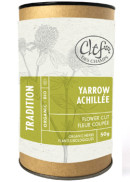
Do not use if you are pregnant or breastfeeding, if hypersensitive to herbs of the Asteraceae family. Keep out of reach of children
 Loose Tea
50g
Adults drink 2 - 3 cups per day. Pour 1 litre of boiling water over 3 tbsp of herbs, cover and let steep for 15-25 minutes. Filter.
- Slightly Astringent Taste
- Useful Sedative, Anti-Inflammatory, Digestive, Antispasmodic, And Tonic
- No additives, colouring, added sugar, gluten, soy or GMOs.
- Kosher and vegan

Herbalist Recommended Tinctures, Teas, & Capsules
Clef des Champs is a Canadian company that was founded by an herbalist in Quebec. All of their herbs are organically grown in their own garden in the Quebec mountains. The natural elements nourish each herb until it’s ready to be picked, dried and made into one of their natural formulations. Their blends offer support for many health concerns including; oral health, women’s health, immune and respiratory health, digestive health, men’s prostate health, and muscle and joint relief. Available in water-alcohol, alcohol-free, capsule, syrup or salve formula’s, Clef des Champs uses the healing power of herbs to support your needs. Read more >
- Reviews
- POST A NEW REVIEW
Reviews By Rating
helpful votes
0
0 customers found this product review helpful
YARROW - HELPS DIGESTION
Mode Of Action
Yarrow infusion contains bitter principles that help digestion and absorption by stimulating appetite, increasing the production of gastric juices and hepatic functions. Rich in anti-inflammatory volatile oils (azulenes), it calms inflammation of all the mucus membranes of the body. In the digestive tract, it relieves the symptoms of colitis, diverticulitis, irritable bowel and gastritis. The complementary actions of its astringent tannins and its antiinflammatory azulenes repair the mucus membranes. Yarrow infusion reduces excess heat and humidity in the body, relieves diarrhea and decreases putrefaction in the intestines. It is antispasmodic, carminative and calms gastric upsets, intestinal cramps and flatulence.
As a warm infusion, yarrow is an excellent diaphoretic which helps relieve fever. It decreases inflammation of the respiratory tract mucus membranes and those of the ear, nose and throat. It is also antimicrobial and mildly expectorant.
As a cold infusion, yarrow is a tonic of the female reproductive system. As both a hormone regulator and a liver tonic, it is very efficient to restore hormonal balance. It regulates levels of both progesterone and estrogen. It is used in all phases of a woman’s life to regulate the menstrual cycle, decrease PMS and relieve symptoms of menopause (abnormal bleeding, hot flashes). As an emmenagogue, it stops excess menstrual bleeding and brings on delayed menses. Achillea millefolium is astringent and tonic and relieves uterine and pelvic congestion. It is helpful for prolapsed uterus, leukorrhea, endometriosis and fibroids accompanied by bright red bleeding. Its anti-inflammatory action relieves pain caused by those conditions and its antispasmodic action relieves menstrual cramps. It can also be used as a sitz bath to relieve cramps of the pelvic region.
Achillea millefolium stimulates blood circulation and tones the blood vessels (varicose veins, hemorrhoids). As a hemostatic, it stops all types of bleeding. Its diuretic, anti-inflammatory and antimicrobial effects of the urinary system are much appreciated in cases of bladder infections.
The main constituents of yarrow and essential oils (1,8-cineole, pinenes, camphor, eugenol, azulenes), flavonoids (resveratrol, apigenin, luteolin, quercetin, artemetin, rutin), sesquiterpene lactones, tannins, alkaloids (achilleine), phytosterols, polysaccharides, fatty acids, vitamins, minerals and trace elements.
Helpful Associations
Red Raspberry infusion for all troubles of the female reproductive system.
Shepherd’s Purse for excess menstrual bleeding.
Hormonatop for hormone imbalance, PMS, symptoms of menopause.
Feminatop for fibroids, cysts, endometriosis.
Chamomile infusion for inflammatory digestive troubles.
Cardiotop for troubles of blood circulation.
Uses
Reproductive and endocrine systems: PMS, leukorrhea, excessively long menstrual cycle, late menses, symptoms of menopause, prolapsed uterus, endometriosis, fibroids, menstrual cramps, spasmodic pelvic pain.
Digestive system: liver health, loss of appetite, gastritis, colitis, diverticulitis, irritable bowel, SIBO, dyspepsia, diarrhea, flatulence, intestinal cramps, prolapsed rectum.
Cardiovascular system: weak blood vessels, varicose veins, hemorrhoids, high blood pressure.
Other: bladder infection, urinary incontinence, kidney stones, nasal congestion, fever, allergies, bleeding, multiple sclerosis.
History
Yarrow has been used for a very long time throughout the world. It was already present in Greek mythology, mostly as a vulnerary to heal wounds and stop nosebleeds. Dioscorides recommended it as a hemostatic herb. In America, the Cherokee applied fresh leaves on wounds to stop the bleeding, they used the infusion for fevers and insomnia and smoked the dried leaves as a decongestant. The Mohawks used the decoction against cramps, nausea and vomiting. Grieves tells us that yarrow was used during the war to treat wounds on the battlefield where medication was scarce. In Germany, yarrow seeds were added to beer barrels as a conservation agent. It is used today as a cholagogue in many products for the liver and for gastro-intestinal health.
Back to Top ↑