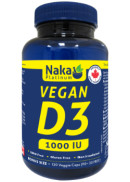
- 25mcg (1000IU)
- Vitamin D3 (Cholecalciferol, sourced from algae)
Do not take if seal is broken. Keep out of reach of pets and children. For freshness, store in a cool and dry place.
 Veggie Caps
120 V-caps
Adolescents 9-18 years old: 1 capsule, 1 time per day.
Adults: 1 capsule, 1 time per day.
- Vegan
- Sourced from natural algae
- Lanolin free
- Helps support and maintain immune function
- May reduce the risk of developing osteoporosis

Premium Quality & Canadian Made - 12 New Added
Founded in 1991, Naka’s success has been built upon introducing innovative supplements in liquid or easy-to-swallow capsule forms designed to meet the better health needs of consumers worldwide. Their most popular supplements include: Naka Pro Collagen, Naka Vital Greens, Naka Magnesium Bisglycinate, Naka Nutri Flex, Naka Vital Greens and Naka Probiotics.You can find Naka herbs and buy Naka supplements at NationalNutrition.ca Read more >- Reviews
- POST A NEW REVIEW
vitamin D 1000 IU - Beyond Bone Health
Surprising new research reveals that vitamin D is not just for bone health. It plays a critical role in the health of the brain and nervous systems, and the cardiovascular and immune systems, as well as in pregnancy and child development. One recent study found that people who took vitamin D supplements had a 7% lower risk of death than those who did not, and many ailments are now being linked to vitamin D deficiency.
Called the sunshine vitamin, vitamin D is formed naturally in the skin by exposure to sunlight. But when a person does not get enough sun exposure, their body cannot make sufficient vitamin D.
Why is vitamin D Deficiency increasing?
We are experiencing an unprecedented epidemic of vitamin D deficiency, with resulting health problems, because so many people are now avoiding exposure to sunshine due to the risk of skin damage and skin cancer from UV rays.
People living in places like Canada, where the sun is not strong enough from mid-September to mid-May to stimulate vitamin D production in the skin, are at risk of developing a vitamin D deficiency. Vitamin D has a half-life of about two weeks. After mid-September, a rapid drop in vitamin D levels leaves most people susceptible to increased incidence and severity of colds, flus, and infections, and increased risk of degenerative diseases.
The right form of vitamin D for the human body
Only the natural form of vitamin D enhances human health. When buying a vitamin D supplement it is important to get vitamin D3 (also called cholecalciferol). This is the form made by your skin on a sunny day.
Some supplements contain vitamin D2 (also called ergocalci- ferol), a form synthetically derived from vegetables. Ergocal- ciferol does not normally occur in the human body and may actually impair vitamin D actions in the body (Cannell).
Natural Factors Vitamin D is in the preferred D3 form and is available in a 1,000 IU potency. Three delivery forms are available: tablet, softgel or liquid. The softgel contains organic flaxseed oil, which increases the bioavailability of vitamin D. The convenient liquid, which can be taken alone or added to smoothies, is in a base of organic olive oil. Olive oil is an excellent natural preservative and also enhances the bioavail- ability of vitamin D.
How much vitamin D is needed?
A person with fair skin with full body exposure to sunlight can produce up to 20,000 IU of vitamin D3 in just 20 minutes. New research shows that the medical profession has vastly underestimated the amount of vitamin D required to maintain good health. While Health Canada currently recommends a maximum dose of only 1,000 IU daily, experts now suggest adults take up to 5,000 IU daily in winter or whenever expo- sure to sunlight is limited. Published scientific research has confirmed that there is no risk of toxicity from vitamin D3 supplements in doses below 10,000 IU per day.
How Does Vitamin D Work?
Vitamin D is produced when sunlight converts cholesterol in your skin into a form of vitamin D3 called calciol. Then the liver hydroxylates calciol into a form called calcidiol (25-hydro- xyvitamin D3). The kidneys then hydroxylate calcidiol into the active form of vitamin D called calcitriol (1,25-dihydroxy- vitamin D3).
Calcidiol, the inactive form of vitamin D3, is circulated and stored in the body. This is the form that should be measured during a blood test of vitamin D3 levels. Researchers now recommend that blood levels of calcidiol be maintained at 50 ng/mL or 125 nmol/L, the level at which vitamin D actually has broader health benefits.
Virtually every cell in the human body has receptors for vitamin D3 because it is not just a vitamin, it is also a hor- mone. As a hormone, it regulates cellular production of important proteins and peptides. Vitamin D3 also affects the expression of many genes, including ones that are key factors in the development of cancer.
The many benefits of Vitamin D3
• Maintains bone, joint and muscle health
• Supports the brain and nervous system
• Reduces the risk of cardiovascular disease
• Supports the health of mother and child during pregnancy and lactation
• Strengthens the immune system, reducing the incidence and severity of bacterial infections
• Improves lung function, especially in former smokers
• Reduces the risk of cancer
• Inhibits skin cell growth associated with psoriasis and other skin conditions
• Helps maintain adequate insulin levels for people with type II diabetes
Bone, Joint and Muscle Health
All the body's structural components – the bones, joints and muscles – require vitamin D3 to remain strong and healthy. Ailments arise when vitamin D3 levels are insufficient. Vitamin D defi- ciency is prevalent among the elderly, as is osteoporosis, a condition where the bones fracture easily because they have become thin, porous and brittle. Vitamin D supplementation can reduce osteopo- rosis and hip fractures (Murray). One study found that supplementation with 700 IU daily reduced the annual rate of hip fracture from 1.3% to 0.5%, nearly a 60% reduction.
Human muscle tissue has receptor sites for vitamin D3. Studies involving elderly people show that those with higher vitamin D3 serum levels have greater muscle strength and fewer falls. Some nursing homes have drastically reduced the number of broken hips from falls by supplementing with vitamin D3.
Intense bone and muscle pain (osteoma- lacia) results from vitamin D deficiency. Out of 150 children and adults who went to a Minnesota hospital in the winter- time complaining of bone and muscle pain, 93% were found to be deficient in vitamin D. A clinical study in Switzerland found chronic pain was eliminated in two-thirds of patients within three months of supplementing with adequate doses of vitamin D.
Brain Health
Several studies have found that high circulating levels of vitamin D3 were linked with a lower risk of multiple sclerosis (Munger, et al). Vitamin D3 supplementation has been shown to reverse the inflammation associated with Parkinson's disease, multiple sclerosis and age-related dementia.
Vitamin D3 has profound effects on the brain, including the neurotransmitters involved in depression. Both depression and suicide peak from January to April, when vitamin D3 levels are lowest. A University of Toronto study found that the incidence of depression was reduced for people taking 4,000 IU of D3 daily.
Vitamin D3 can help with Seasonal Affective Disorder (SAD), also known as "the winter blues". A small placebo- controlled trial found that everyone who received the vitamin D3 supplement showed an improvement in mood, as measured using several standard psychological tests.
Cardiovascular Health
A recent study, which tracked 1,354 men for 10 years, found that low vitamin D3 levels were associated with a doubling of the risk of a fatal heart attack. This suggests that supplementing with vitamin D3 could reduce that risk. One of the researchers estimated that to move from deficiency to sufficiency would require about 3,000 IU of vitamin D3 daily. He said Health Canada's "upper tolerable limit" of 2,000 IU "may be too conservative".
Scientists have found that women over the age of 65 who took vitamin D supple- ments had nearly one-third less risk of dying from heart disease. Because vita- min D is an important calcium absorp- tion regulator, high levels reduce the risk of calcification of the arteries, while low levels accelerate calcium build up in the arteries.
Pregnancy and Child Development
Adequate levels of vitamin D are critical for pregnant and lactating women and their babies. One study examined 400 in- fant/mother pairs, of various races, at birth and found that 48% of the mothers and 52% of the infants had insufficient levels of vitamin D.
Vitamin D is essential for the develop- ment of the child's brain, nerves, and skeleton. It has been observed that children born in the winter, when the mother's vitamin D levels are lowest, have a greatly increased risk of eventually developing diabetes, rheumatoid arthritis, multiple sclerosis and many common cancers. Vitamin D is also essential for the mother, to prevent bone loss and preeclampsia, a serious compli- cation of pregnancy.
The Preferred D3 Form of vitamin D!
Natural Factors Vitamin D3 1000IU Supports bone development, helps the absorption of calcium and supports nervous system health.
Vitamin D plays a dual role as both a vitamin and a hormone that stimulates the body to absorb calcium. Vitamin D, calcium, and phosphorus are needed to keep bones strong. Without vitamin D even a diet adequate in calcium will not help as the body needs vitamin D to absorb calcium. People with low vitamin D levels tend to have soft, thin bones, predisposing them to fractures, especially hip fractures. Soft bones can also cause the nagging and unremitting bone pain that many older persons suffer from.
Vitamin D supplementation is important because it's hard to get enough during long, dark, northern winters. The elderly have more difficulty synthesizing vitamin D from sunlight, some medications interfere with vitamin D absorption and absorbing calcium which will strengthen bones and prevent fractures.
Vitamin D may be useful in resisting some forms of cancer as well. Breast tissue has receptors for the vitamin D hormone. When cultured outside the body, breast cancer cells do not reproduce as readily and in fact become more normal (differentiate) in the presence of vitamin D. These studies are interpreted as evidence that higher vitamin D levels have an anti-cancer effect on breast cancer cells. There are similar reports concerning prostate cancer and cancer of the large intestine.
Vitamin D3 (cholecalciferol from animal source) is the form found in fish oils and eggs, and is produced by sunlight on human skin. Natural Factors vitamin D3 is derived from sheep wool lanolin.
Since 2007, major research studies have shown that vitamin D does much more than prevent bone disease.
From strengthening immunity and reducing the risk for heart disease, to helping prevent multiple sclerosis and even certain cancers, most people can benefit from vitamin D supplementation.
The newest research suggests that low levels of the "sunshine vitamin" may be part of the reason we get more colds and flu in winter. Increasing year-round vitamin D intake could be another natural way to ward off viral and bacterial infections.
Vitamin D through the ages
By Dr. Kate Rhéaume-Bleue
Vitamin D is one of the most fundamentally important nutrients to obtain and maintain health from conception to old age. Research is pouring in confirming that deficiency is common and it's causing problems in all stages of life. One study has linked low vitamin D levels in mothers to a five-fold increase risk of preeclampsia, a serious complication in pregnancy that can lead to fetal death. Several others have indicated that between 55 and 70 percent of seemingly healthy adolescents may be vitamin D deficient, putting them at an increased risk of osteoporosis and other health problems later in life. In adults, low blood levels of vitamin D are associated with several types of cancer, high blood pressure, diabetes and increased risk of fractures in the elderly.
Why is this essential nutrient so elusive? After all, vitamin D can simply be synthesized in the skin by sunlight, can't it? Unfortunately in Canada there are substantial portions of the year during which UVB rays are not strong enough to make vitamin D, even at midday. Dark-skinned individuals living in northern latitudes have an especially high risk of D deficiency as melanin slows the production of D in the skin. A trend towards low fat foods, sun avoidance and low consumption of wild-caught, oily fish (our best dietary source of vitamin D) all add up to a widespread vitamin D deficit.
Additional Information
Pregnancy and lactation: Suitable for pregnant and lactating women.
Children: Health Canada recommends 200 IU daily for children of all ages. Emerging research indicates that much higher doses are safe and support optimal health for children.
Drug interactions: Many drugs cause vitamin D deficiencies because they interfere with the absorption and/or metabolism of vitamin D, including cholestyramine (Questran), colestipol (Colestid), phenytoin (Dilantin), phenobarbital, orlistat (Xenical), and mineral oil. Also, corticosteroids, such as prednisone, increase the need for vitamin D.
Contraindications: People using digoxin (Lanoxin) and thiazide diuretics should consult a health care practitioner before supplementing with vitamin D. People with liver or kidney disease, primary hyperthyroidism, lymphoma, tuberculo- sis and granulomatous diseases should consult a health care practitioner before supplementing with vitamin D.
Most people experience some degree of vitamin D3 deficiency, but an explosion of research is showing that taking a vitamin D3 supplement can improve physical and mental health, and reduce the risk of infections and degenerative diseases.
Back to Top ↑