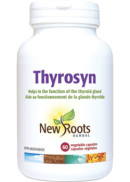
- 125mg
- L-Tyrosine
- 67mg AT
- Vitamin E (D-Alpha Tocopheryl acetate)(100IU)
- 60mg
- Adrenal Gland Concentrate (from Sus scrofa) (3:1)
- 40mg
- Spleen (from Bos taurus)
- 10.5mg
- Potassium (from potassium citrate)
- 5mg
- Coenzyme Q10
- 5mg
- L-Cysteine hydrochloride
- 5mg
- Kelp (Ascophyllum nodosum), 0.1% iodine
- 5mg
- L-Cysteine
- 5mg
- Myrtle (Myrtus communis)
- 5mg
- Myrrh (Commiphora myrrha)
Contains no: preservatives, artificial flavour or colour, sugar, milk, starch, wheat, yeast, citrus or egg.
 Veggie Caps
60 V-caps
Take 1 capsules 3 times daily or as directed by your health care provider.
- Natural support for the thyroid gland.
- With amino acids, glandulars, vitamins and supportive nutrients.
- May help those with under active thyroid.
- Supports balanced functioning of the endocrine system.
- In a non GMO vegetable capsule.

Proudly Manufactured In Canada & Available National Nutrition.
New Roots Herbal offers high-quality natural health products like their best-selling probiotics, digestive enzymes, chill pills, strong bones, acidophilus ultra and black cumin seed oil among hundreds more herbal remedies. Founded in 1985 New Roots Canada delivers formulas that were designed to address health imbalances and support the body's natural healing processes and overall well-being. You can buy all New Roots supplements at National Nutrition.ca Read more >- Reviews
- POST A NEW REVIEW
Reviews By Rating
helpful votes
7
7 customers found this product review helpful
The Thyroid Gland
The thyroid gland secretes two hormones, T3 which is triiodothyronine, and T4 which is thyroxine. These hormones function to produce energy from food. Therefore too much produces hyperthyroidism and too little hypothyroidism. Hyper is associated with weight loss and rapid heart beat. It is usually treated by removal of part of the thyroid gland. Hypo is a much more common occurrence and affects large proportions of the population. The most common cause is either inadequate production of thyroid hormones by the thyroid gland or inadequate production of the thyroid stimulating hormone, TSH, by the Pituitary gland, which cause the thyroid to produce T3 and T4. It is essential to keep the thyroid in balance as thyroid hormones affect many other hormonal systems within your body.
Hyperthyroidism This is when excessive serum levels of thyroid are present, which leads to reduced libido and decreased positive emotions. Both fat and muscle are destroyed, as an excess of thyroid hormones is catabolic.
Hypothyroidism This is when you have insufficient thyroid hormones to help drive your insulin metabolism. This leads to an increased fat to muscle ratio as your metabolic rate is also reduced. So, as well as feeling exhausted and lethargic, your testosterone level is also reduced, leading to decreased libido, just as in hyperthyroidism (this is true for both males and females).
Basic Physiology of Thyroid Hormones
Thyroid production begins in the brain in the hypothalamus which releases TRH [thyrotropin releasing hormone] which in turn stimulates the pituitary to release TSH [thyroid stimulating hormone]. TSH combines with thyroid receptors and AMP is formed from ATP and iodine is transported to the thyroid gland. iodine is oxidized to form monoiodotyrosine [MIT] and diiodotyrosine [DIT]. MIT and DIT combine to form the thyroid hormones thyroxin [T4], triiodothyronine [T3] and reverse T3 [RT3]. RT3 is an inactive form of T3. In the thyroid, the ratio of T4 to T3 is, 75% T4, 25% T3. T4 is converted to T3 in the thyroid and other tissues in the body. T3 is the active form for all cells and tissues, and is more essential than T4. Hypothyroidism appears when T4 is not converting to T3. In hypothyroidism the symptoms appear even though there is an excess of T4 and normal TSH.
SYMPTOMS OF HYPOTHYROIDISM - a picture of slowed metabolism
- Chilliness daytime temperature less than 98F
- Cold and heat intolerance cold hands and feet
- Fatigue, headaches and depression
- Fluid retention - face, legs, eyelids and abdomen
Dry skin, eyes and/or hair; Constipation
FEMALE SYMPTOMS
- PMS - irregular periods
- Headaches, migraines
- Depression, apathy and anxiety
- Irritability - low self esteem
- Low sexual desire
- Memory and concentration impairment
- Enlarged tongue, deep voice and swollen neck
Hypothyroidism often goes undiagnosed as the symptoms are vague or even ignored, particularly so if the blood tests come back normal. This is where integrated medicine is essential, as the doctor must look further than the diagnostic blood tests. Symptoms of low thyroid function must be used as a diagnostic tool. Even if levels fall within the normal range, hypothyroidism is still a possibility and can be determined by taking a simple test. Check your basal under-arm temperature over several days with a basal thermometer taken in the morning as soon as you're awake. If the temperature is, on average, less than 98OF, inadequate thyroid production is usually indicated. In some cases, lab results appear normal and the patient exhibits many hypothyroid symptoms. This is called Wilson's syndrome; the slowing of the metabolism which is characterized by low body temperature, but with thyroid blood tests that seem in the normal range.
Back to Top ↑