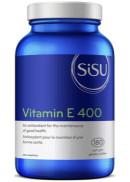
- 400 IU
- Vitamin E (d-alpha tocopherol)
Soybean oil
Capsule shell
Glycerin (vegetable), purified water, gelatin
Contains no dairy, wheat, or artificial preservatives
 Softgels
180 Softgels
Take 1 capsule daily or as directed by a health care practitioner
- Primary vitamin antioxidant
- Natural d-alpha tocopherol
- One-a-day dose
- Promotes Healthy Aging.
- Supports Heart And Immune Functions

- Reviews
- POST A NEW REVIEW
Reviews By Rating
helpful votes
0
0 customers found this product review helpful
f
Sisu Vitamin E 400
Oxidation is a natural and necessary process in which cells are broken down or converted to other forms. Although oxidation reactions are crucial for life, if accelerated, the process can be damaging. Plants, animals and people maintain complex multiple antioxidant systems including vitamins, minerals, enzymes, and dietary antioxidants. Pollution, physical and mental stress, drugs, alcohol and other chemicals can increase oxidation, which generates free radicals that are linked to age-related degenerative conditions including vision problems, heart disease, diabetes, osteoporosis, and Alzheimer's disease. Vitamin E is a primary, fat-soluble antioxidant that protects the cells. In food, it is found in nuts, seeds, avocado, eggs and leafy greens. It is wise to consume antioxidants from a wide variety of sources to support overall health.
Product Information
-Natural vitamin E in a base of soybean oil
-Works with other antioxidants to prevent free radical damage to cell membranes
-Inhibits oxidation, blood clotting and is a factor in cardiovascular health
-Deficiency is linked to neurological conditions
SISU Advantages
-High potency capsule, convenient dose of one capsule per day
-Contains no ingredients that are a source of gluten
-GMP standards
-Tested for guaranteed potency and purity
-NPN approved
Vitamin E
Vitamin E is a group of fat-soluble vitamins that act as antioxidants and thus neutralize free radicals. Free radicals are unstable molecules with an unpaired electron that are extremely reactive and damage surrounding cell membranes, fats, and fat soluble vitamins and nutrients. We encounter free radicals through environmental exposures, such as cigarette smoke, air pollution, and ultraviolet radiation from the sun (UV rays).
In doses less than 150IU per day, Vitamin E has been shown to increase life-span (by reducing all-cause mortality). Vitamin E is well known for the prevention of cardiovascular disease in a few different ways. First, it decreases platelet aggregation (clot formation), thus allowing the blood to flow more freely and bring more oxygen to the tissues. Also, as an antioxidant, vitamin E protects our artery walls from damage and prevents the oxidation of LDL cholesterol, both of which contribute to arterial plaque formation when left untreated.
Antioxidant properties allow vitamin E to be useful in supporting healthy cell growth by reducing free radical damage to cellular genetic material. Vitamin E is also believed to be an anti-aging vitamin because its antioxidant effects reduce the cell damage that can lead to visible aging. Cataracts are caused by free radical damage of the lens of the eye and therefore vitamin E can help to prevent this damage. It has also been shown to be anti-inflammatory by inhibiting inflammatory pathways in the body. Vitamin E has been found to be protective against Alzheimer's disease, atherosclerosis, and diabetes mediated liver damage, as well as PMS. It is also used to treat many existing conditions including infertility, fibrocystic breasts, anemia, and topically for scars.
Subtypes of Vitamin E
There are two groups of compounds that make up vitamin E: tocopherols and tocotrienols. Each group contains four different forms that are named by the Greek letters alpha, beta, gamma and delta. The most biologically prevalent of these forms is the naturally sourced d-alpha-tocopherol.
Although previously overlooked due to their lower levels, recent research has brought tocotrienols into the spotlight. It has been found that tocotrienols possess powerful neuroprotective and cholesterol-lowering properties outside those exhibited by tocopherols. Recent research suggests that the various forms of vitamin E are not redundant in their health benefits, and thus a supplement containing all subgroups of both tocopherols and tocotrienols is preferred for general supplementation, although specific conditions can be targeted with certain subgroups.
Natural vs. Synthetic Vitamin E
Synthetic alpha-tocopherols are listed as "dl" (dl-alpha-tocopherols), as opposed to their natural d-alpha-tocopherol counterparts. These synthetic mixtures contain equal amounts of eight different stereoisomers of alpha-tocopherol, four of which are absorbed, and only one of which is the naturally occurring d-alpha-tocopherol. Thus, although synthetic alpha-tocopherols are less expensive, they are half as active by dose as naturally sourced options and may have different side-effects.
Back to Top ↑