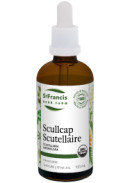
- 250 mg
- Scullcap (Scutellaria lateriflora, flowering tops) QCE (1:4)
- QCE = Quantity Crude Equivalent
Consumption with alcohol or other sedatives is not recommended. Consult a health care practitioner: if symptoms worsen or persist; if sleeplessness persists continuously for more than three weeks. Do not use if you are pregnant or breastfeeding. Some people may experience drowsiness. Exercise caution if operating heavy machinery, driving a motor vehicle, or involved in activities requiring mental alertness.
 Liquid
100ml
Take 1-2 ml (30-60 drops) 3 times daily or as needed in a little water on an empty stomach. May also be taken as a one-time 3-6 ml (90-180 drops) daily dose in a little water at bedtime.
- Traditionally used in Herbal Medicine as a sedative to help relieve nervousness
- Helps relieve insomnia
- Help relieve the pain associated with menstruation
- Relief from tension headaches
- Traditionally used for the pain attending teething in children
- Gluten-free

Wild Crafted & Organic Liquid Herbs - 50 New Added
St. Francis Herb Farm is a leading natural health and herbal supplement company with popular immune-supporting products like Deep Immune and Chest Rub. They also offers a top-selling stress-supporting supplement, Strest Adrenal Tonic. St. Francis Herbs use high-quality herbs and delivers on quality. Read more >- Reviews
- POST A NEW REVIEW
SCUTELLARIA LATERIFLORA
Do you lie awake at night, anxious or tense, going over all of the tasks that must be accomplished the following day?
Skullcap may be just what you need to let it all go and help you to get to sleep and better cope with your demanding lifestyle.
Scutellaria grows in the damp woodlands or swamps of Eastern North America. It has pointed leaves and many two-lobed violet blue (sometimes pink) flowers. All aerial or above ground parts of this perennial are dried and used medicinally.
Native tribes in the eastern parts of the United States were the first to use Skullcap medicinally. At that time it was used to treat female conditions, including menstrual pain or irregularity. It went on to become the cure for rabies in the 1700’s, which also explains why many know it as mad-dog weed or mad-dog skullcap. Although we now know that skullcap was not a cure, it does alleviate some of the symptomology such as twitching or convulsion. Today, the use of skullcap is centered on its efficacy with nervous conditions, such as anxiety, stress, muscular spasm or tension due to stress and insomnia.
Although Scutellaria has not been studied extensively in terms of its medicinal properties, it is believed that one of its more abundant flavanoids, scutellarin, is responsible for its sedative, nervine and anti-spasmodic effects. As well as treating tension, anxiety and insomnia, it is also commonly recommended for tension headaches, menstrual cramping, fibromyalgia and mild cases of Tourette’s or seizure disorders. Research is also now suggesting that this same flavanoid may improve blood flow in patients prone to clots, those suffering from cerebral thrombosis or stroke induced paralysis.
As with most herbs, skullcap can be used as a tincture, made into a tea or infusion, as well as powdered and used in capsules. Although there are no safety issues with the herb itself, there have been a number of reports of patients suffering liver damage following consumption of a similar herb that is often mislabeled as skullcap. A dosage of anywhere from 3-6 g/day is considered safe and effective. If combined with other herbs, the dosage may be considerably less, as to allow the formula a more synergistic effect.
Scutellaria Lateriflora (Sullcap) – QUICK FACTS
PARTS USED
· Dried aerial parts
APPLICATIONS
· Insomnia, tension, muscular tension, anxiety, menstrual cramping and headache.
OPTIMUM DOSAGE
· 1-3 g twice daily.
WORKS WELL WITH
· Valerian, Passionflower, Hops or Lemon balm.
IMPORTANT INFORMATION
· Skullcap is considered safe and non-toxic, although be sure that you are getting only skullcap and it is from a reputable company. The liver damaging effects some individuals have reported are thought to be via cross contamination with another herb.
Back to Top ↑