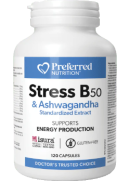
- 75mg
- Ashwagandha Extract (Withania somnifera) (root and leaf) (standardized to 8% withanolides, 2% withaferin A, 32% oligosaccharides)
- 50mg
- Vitamin B1 (Thiamine Hydrochloride)
- 50mg
- Vitamin B2 (Riboflavin)
- 50mg
- Vitamin B3 (Niacinamide)
- 50mg
- Vitamin B6 (Pyridoxine Hydrochloride)
- 50mcg
- Vitamin B12 (Cyanocobalamin)
- 1mg
- Folate (Folic Acid)
- 50mg
- Pantothenic Acid (Calcium-d-pantothenate)
- 50mcg
- Biotin
- 50mg
- Inositol
- 50mg
- Choline Bitartrate
Gelatin capsule (gelatin, water), rice flour, cellulose, silica, vegetable grade magnesium stearate (lubricant).
Consult a health care practitioner prior to use if you are pregnant or breastfeeding. Consumption with alcohol, other drugs or natural health products with sedative properties is not recommended.
 Capsules
120 Caps
Adult dose: 1 capsule daily with food or as directed by a health care practitioner.
- Decrease Stress levels
- Relieve mild nervousness
- Metabolize carbohydrates, fats and proteins
- Increase red blood cells
- Reduce neural tube defects when taken prior pregnancy
- Contains no dairy, sugar, wheat, gluten, yeast, soy, egg, fish, shellfish, salt, tree nuts, or genetically modified genes or proteins

Wellness made simple with Preferred Nutrition at National Nutrition
Preferred Nutrition makes quality natural health supplements to support your overall health needs. Top products include: MagSense for muscle pain, NEM for joint health, Saw Palmetto Plus Vitex to support hormone balance, Stress B to naturally support stress and UTI drops to help infections naturally. Read more >- Reviews
- POST A NEW REVIEW
Reviews By Rating
helpful votes
6
6 customers found this product review helpful
WHAT YOU CAN EXPECT FROM STRESS B50 & ASHWAGANDHA:
-Decrease Stress levels
-Relieve mild nervousness
-Metabolize carbohydrates, fats and proteins
-Increase red blood cells
-Reduce neural tube defects when taken prior pregnancy
-Factor in the maintenance of good health
There are eight B vitamins in vitamin B complex as well as several related nutrients. These include thiamine (B1), riboflavin (B2), niacinamide (B3), pyridoxine (B6), cyanocobalamin (B12), folic acid, pantothenic acid and biotin. The other related nutrients are choline and inositol.
Although each individual vitamin or related nutrient performs a different function in the body, they all work together to maintain good health and vitality. A well balanced diet should provide us with all the B vitamins we require, but because they are water soluble and therefore not retained by the body, we need a daily dietary source.
B Vitamins are absolutely essential to your body's energy production, fat metabolism, stress management and other vital processes.
B VITAMINS
B vitamins are a group of water soluble nutrients that play a vital role in cellular metabolism and are dispersed throughout the body...
B vitamins need to be replenished on a regular basis, as excesses are excreted in the urine. The rest of the B vitamin family can be found in whole grains, legumes and lentils, nutritional yeast, meat, eggs (egg yolk), liver, cheese, fish, spinach and other leafy greens, to name just a few sources.
B vitamins work best when used in combination with each other, as in a B complex supplement. It is best to take B complex supplements (usually found in 50-100 mg/capsule dosages) in divided dosages throughout the day, as opposed to all at once.
This avoids excess being lost in urine. Individuals who suffer from impaired digestion (elderly) or inflammation of the digestive tract, such as IBD, are at a higher risk of being deficient in B vitamins. Many B vitamins are available in sublingual forms for better absorption, or can be taken via intramuscular injection (IM), to bypass the digestive system, as well as allow for higher dosing.
STRESS
Stress is usually thought of as a negative factor in our daily lives but it is necessary part of life. Without stress life becomes boring. The key to stress, as with everything else in life, is balance. Enough to keep you interested but not enough to become overwhelmed. Individuals have different thresholds for stress. What is seen as stressful to one person may not be stressful to another.
The stress response is the body's way of preparing for action. As our species evolved it kept us safe, allowing us to fight for survival, or to flee from dangerous situations. The sympathetic nervous system response involves increased heart rate, blood pressure and adrenal output, as well as increased blood flow to the brain, muscles, lungs and heart. Those organs that are not needed to fight or flee receive less blood flow, for example, the digestive organs. This response is very efficient for a short period of time but it is meant to be used sparingly.
Emotional stress can be caused by any emotion including love, hate, anger and envy.
Chemical stressors are microbes, poisons, oxygen deprivation, drugs, nutrient deficiency, pollution, alcohol and junk foods.
Physical stressors are loud noises, x-rays, UV light, gravity and temperature. Nowadays our body's reaction to stress is seen as inappropriate, because the stressors we face are not usually life-threatening or dangerous, yet our body responds as it always has.
The result of constant stress can be tense muscles, headaches, stomach cramps, teeth grinding, decreased immunity, exhaustion and insomnia. Emotionally stress can lead to memory problems, depression, emotional outbursts and panic attacks. It is believed that constant stress is a factor in the development of many chronic diseases.
Irregular sleeping and eating patterns make one susceptible to stress related illness. Sleep is an essential component of our body's repair mechanisms. During sleep the body is in an anabolic, or building, state. It has time to regenerate cells and replenish hormones, enzymes and neurotransmitters. Insomnia prevents the repair of normal damage from the body's daily activity. The brain also requires sleep in order to process information that is learned throughout the day.
Irregular eating patterns stress the body by not providing nutrients at regular intervals. When the body is lacking nutrients it compromises the body's functioning. When an individual finally does eat the body rushes to use the nutrients and store whatever it does not need, in anticipation that the next meal may not come for a while.
Lack of exercise contributes to stress by compromising the circulation of all molecules around the body, including food particles, oxygen and hormones. Circulation is also responsible for flushing waste products out of the cells and taking them to the appropriate organs for processing and excretion. The venous system contains no values so blood flow back to the heart is dependent on movement of the surrounding musculature. Exercise also removes tension from muscles and offers an outlet for unexpressed emotions.
Back to Top ↑